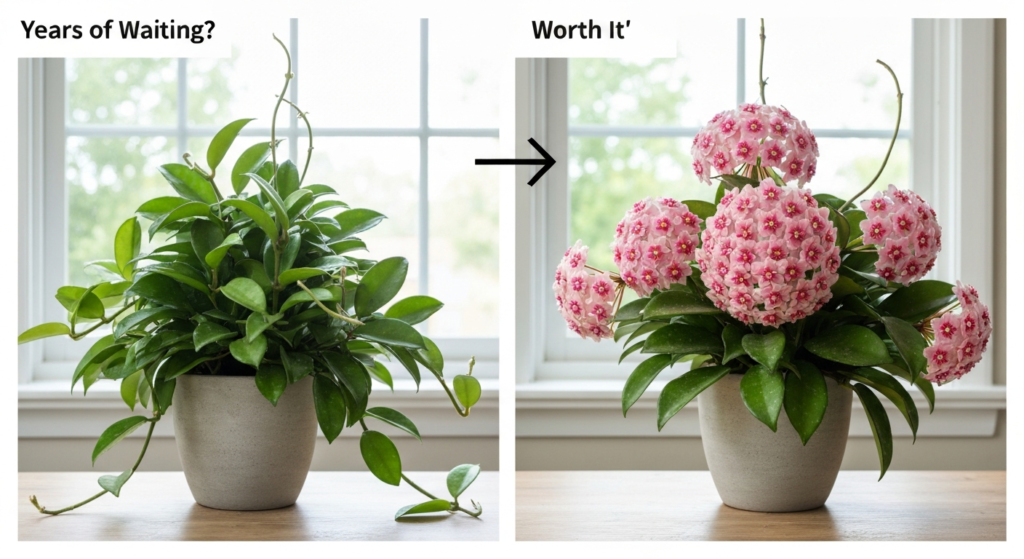

You’ve been caring for your Hoya rope plant for two, maybe three years now. The vines keep growing, the leaves look healthy, but there’s one problem: no flowers. You start wondering if you bought a dud, or if maybe you’re missing something obvious. Every time you see those gorgeous porcelain flower clusters online, you feel a little frustrated with your own bloomless plant sitting on your shelf.
Here’s the thing—you’re probably not doing anything wrong. Hoyas are notoriously slow to reach blooming maturity, and most people give up right before their plant is about to reward them. The good news? Once you understand what triggers those waxy, fragrant blooms, you can actually make it happen.
In this guide, I’ll walk you through exactly how long you need to wait, what conditions push Hoyas to flower, and the one mistake that resets your progress completely.
Understanding Hoya Rope Plant Maturity
The biggest reason your Hoya isn’t blooming is simple: it’s not old enough yet. These plants don’t flower on a predictable schedule like some houseplants. They bloom when they reach a certain level of maturity, which has more to do with the plant’s development than the calendar.
How Long Until First Blooms?
Most Hoya carnosa (the classic rope plant) takes 3 to 5 years from propagation to produce its first flowers. Some varieties bloom sooner, others take longer. I’ve seen well-cared-for plants bloom at 2 years, and I’ve heard from growers who waited 7 years.
The timeline depends on several factors:
- Propagation method: Plants grown from cuttings take longer than those grown from mature divisions
- Growing conditions: Optimal light and care speed up maturity
- Variety: Hoya pubicalyx and Hoya polyneura often bloom younger than carnosa
- Vine length: Most Hoyas need vines at least 3 feet long before they’ll consider flowering
When I bought my first Hoya as a small rooted cutting, I expected flowers within a year based on what I’d read online. That was unrealistic. The plant focused on establishing roots and growing vines for the first two years. Year three brought longer vines but still no buds. Year four finally delivered—multiple flower clusters that made the wait completely worth it.
Signs Your Plant Is Approaching Bloom Maturity
You can’t rush maturity, but you can watch for signs that flowering is getting closer:
- Vines reach 3 to 4 feet in length
- New growth becomes more frequent during the growing season
- The plant fills its pot with roots (slight root binding actually helps)
- Leaves develop a waxy, thick texture rather than soft, juvenile foliage
These aren’t guarantees, but they indicate your plant is building the energy reserves it needs to produce flowers.
The Peduncle Rule: Never Cut Them Off
This is the most important thing you need to know about Hoya care, and it’s where many growers unknowingly sabotage themselves.
What Are Peduncles?
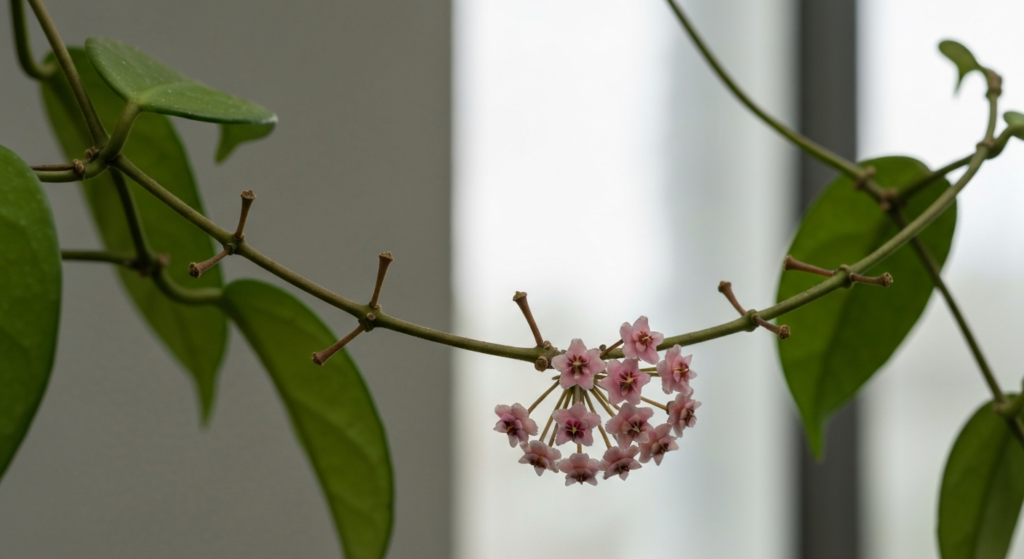
After your Hoya blooms for the first time, it leaves behind small stem-like structures called peduncles (sometimes called spurs). They look like tiny brown or green stubs sticking out from the vine where flowers used to be. They’re not attractive, and your first instinct might be to trim them off for a cleaner look.
Don’t do it.
Hoyas bloom from the same peduncles year after year. When you remove them, you’re cutting off future flowering sites. The plant has to generate entirely new peduncles, which delays blooming and reduces the number of flower clusters you’ll get.
What Peduncles Look Like
| Feature | Description |
|---|---|
| Size | 1/4 to 1/2 inch long |
| Color | Brown, green, or grayish depending on age |
| Texture | Woody or slightly rough |
| Location | Between leaf nodes on mature vines |
| Appearance after blooming | Dried flower remnants may cling to them initially |
I made this mistake with my first Hoya. After the initial bloom, those little stubs looked messy, so I snipped them off during routine grooming. The next year, I got significantly fewer flowers. It took me a while to connect the dots, but once I stopped removing peduncles, my bloom count increased each season.
How to Handle Old Flower Clusters
When the flowers fade and die, you can remove the dried blooms themselves, but leave the peduncle intact. Gently pinch or cut off the spent flowers right where they attach to the spur. The peduncle stays on the vine permanently.
Over time, mature Hoya vines develop multiple peduncles along their length. Some of my older vines have 8 to 10 peduncles, and during peak blooming season, several produce flowers simultaneously. That’s the payoff for leaving them alone.
Humidity: The Bloom Trigger Most People Ignore
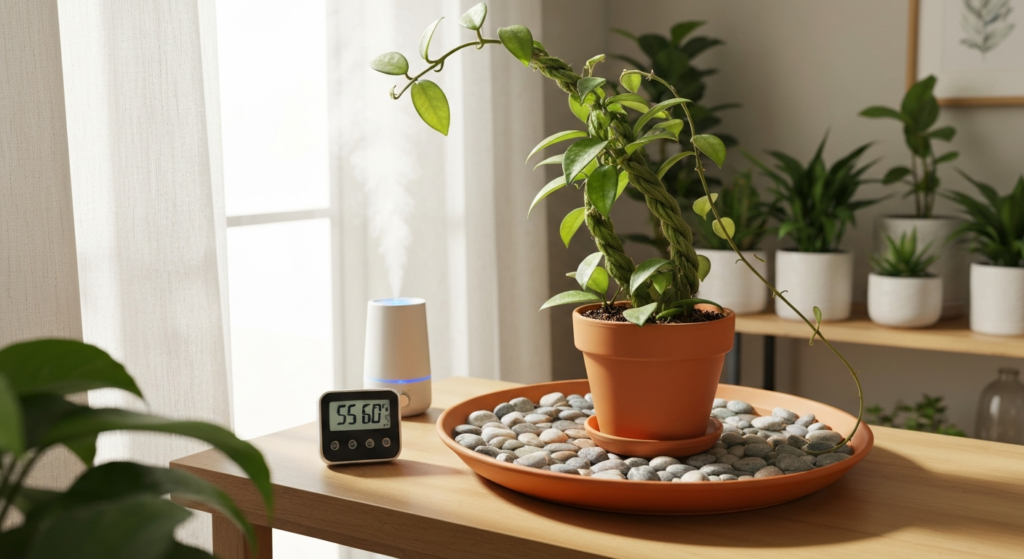
Hoyas will survive in average household humidity, but they won’t necessarily bloom. In my experience, humidity makes the difference between a plant that flowers reluctantly and one that blooms reliably.
Ideal Humidity Levels for Blooming
Hoyas prefer 40% to 60% humidity for general health. For consistent blooming, aim for 50% to 70%. During winter when indoor air gets dry, humidity often drops below 30%, which can prevent bud formation even on mature plants.
I noticed this pattern with my own collection. During humid summers, my Hoyas produced multiple bloom cycles. In winter, even with proper light and watering, bud development slowed or stopped entirely. Once I addressed humidity, winter blooming became possible.
Practical Ways to Increase Humidity
Here are methods that actually work, ranked by effectiveness:
Humidifier: The most reliable option. A cool-mist humidifier near your Hoya keeps humidity stable without creating wet surfaces that invite pests or fungal issues. Run it for several hours daily, especially during heating season.
Pebble Trays: Fill a shallow tray with pebbles and water, then place the pot on top (not in the water). As water evaporates, it raises humidity around the plant. This works best for smaller Hoyas and needs regular refilling.
Grouping Plants: Placing multiple plants together creates a micro-climate with higher humidity through their combined transpiration. This helps, but isn’t enough on its own for bloom-level humidity.
Bathroom Placement: If your bathroom has a window with bright indirect light, it’s an ideal spot. Showers and baths naturally increase humidity. My Hoya pubicalyx blooms most reliably in my bathroom.
| Method | Effectiveness | Maintenance | Cost |
|---|---|---|---|
| Humidifier | High | Weekly refilling | $30-100 |
| Pebble tray | Moderate | Refill every 3-4 days | $5-15 |
| Plant grouping | Low to Moderate | None | Free |
| Bathroom placement | High | None | Free |
| Misting | Low | Daily | $5 |
Skip Misting: Despite common advice, misting doesn’t maintain humidity long enough to help. The water evaporates within minutes, and wet leaves can develop fungal spots. I stopped misting my Hoyas years ago with no negative effects.
Monitoring Humidity
A simple hygrometer ($10-15) tells you exactly what humidity levels you’re working with. Place it near your Hoya and check it at different times of day. If you’re consistently below 40%, your plant needs help, even if it looks healthy otherwise.
Light Requirements for Flower Production
Hoyas grow in low light, but they won’t bloom there. The amount and quality of light directly affects whether your mature plant produces flower buds.
Bright Indirect Light Explained
“Bright indirect light” is vague advice. Here’s what it means practically:
Your Hoya should be near a window where it receives several hours of bright light daily, but the direct sun rays don’t hit the leaves (or only touch them briefly during morning or late afternoon). An east-facing window is ideal. South or west windows work if you filter the light with a sheer curtain or place the plant a few feet back from the glass.
I keep my most prolific bloomer about 3 feet from a south-facing window. It gets bright light all day without direct sun exposure. When I moved it closer to the window, the leaves bleached. When I moved it to a north-facing room, growth slowed and blooming stopped.
Signs of Light Problems
| Too Much Light | Too Little Light |
|---|---|
| Leaves turn yellow or pale | Vines grow long with widely spaced leaves |
| Sunburn spots (brown or white patches) | Dark green leaves but no growth |
| Leaves feel thin or papery | No flower buds form on mature plants |
| Red or purple leaf tints (stress response) | Weak, spindly new growth |
Grow Lights for Blooming
If you don’t have adequate natural light, full-spectrum LED grow lights work well. Position them 12 to 18 inches above the plant and run them for 12 to 14 hours daily. I use grow lights during winter when daylight hours shrink, and my Hoyas maintain their blooming schedule.
Look for lights with both blue and red spectrum coverage. Blue light supports leaf growth, while red light promotes flowering. Many affordable options exist now—you don’t need expensive professional setups.
Support Structures That Encourage Blooming
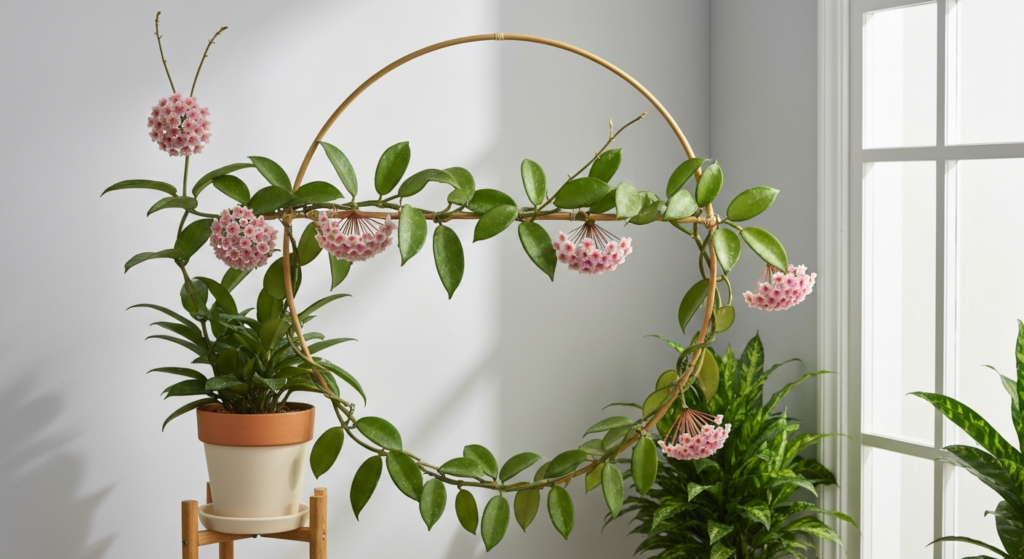
How you support your Hoya affects more than just appearance. The right structure can actually improve blooming.
Why Support Matters
Hoyas bloom more prolifically when their vines have stable support. Constantly moving or disturbing the plant can cause developing buds to drop. A secure structure keeps vines in place and allows peduncles to form in consistent locations.
Best Support Options
Trellis: A simple bamboo or wooden trellis works well. Train the vines horizontally rather than just letting them climb vertically. Horizontal growth encourages more blooming points along the vine length.
Hoop: Wire hoops create a circular structure that shows off the trailing habit while providing support. As vines wrap around the hoop, they develop peduncles on the outer edge where you can easily see the flowers.
Hanging Basket: Letting vines trail naturally from a basket is low-maintenance and looks good. However, you’ll get fewer blooms compared to supported plants because the weight of trailing vines can stress the peduncles.
Wall Hooks: For longer vines, small adhesive hooks let you arrange vines along a wall without drilling. This creates a living wall effect and keeps vines horizontal.
| Support Type | Blooming Impact | Best For | Considerations |
|---|---|---|---|
| Trellis | High | Compact spaces | Allows horizontal training |
| Hoop | High | Display purposes | Easy to rotate for even light |
| Hanging basket | Moderate | Low ceilings | Harder to reach for care |
| Wall arrangement | High | Large plants | Permanent or semi-permanent |
I’ve found that training vines horizontally along a trellis produces the most flower clusters. Something about the horizontal orientation seems to signal the plant to focus on flowering rather than just growing longer.
Training Tips
Secure vines loosely with soft ties or plant clips. Don’t wrap them tightly—you want room for the vine to thicken as it matures. Check ties every few months and adjust as needed.
Avoid moving your Hoya once it’s established and showing signs of blooming. Even rotating the pot can stress developing buds. If you need to turn it for even growth, do so during the dormant period (late fall or winter) rather than during active growing season.
Fragrance Variations Among Hoya Varieties
One of the best parts of Hoya blooms is their fragrance, but intensity varies significantly by variety.
Strongly Scented Varieties
Hoya carnosa: The classic rope plant produces sweet, honey-like fragrance that intensifies at night. My carnosa perfumes an entire room when multiple clusters bloom simultaneously. The scent is strong but pleasant—not overwhelming.
Hoya pubicalyx: This variety has a spicy, almost cinnamon-like scent. It’s less sweet than carnosa but equally strong. I find it more interesting and complex.
Hoya lacunosa: Small flowers but powerful fragrance. Sweet and citrusy with an almost powdery undertone. Despite tiny blooms, the scent carries well.
Lightly Scented Varieties
Hoya kerrii: The sweetheart Hoya produces small, lightly scented flowers. You need to get close to smell them, and the fragrance is subtle—mildly sweet.
Hoya australis: Light chocolate scent, but only noticeable if you put your nose right up to the flowers. Still worth growing for the blooms themselves.
Scent Timing
Most Hoyas release stronger fragrance in the evening and at night. This is an evolutionary trait—in their native habitat, they’re pollinated by night-flying moths attracted to the scent. If your blooms seem scentless during the day, check them again after sunset.
Temperature also affects fragrance intensity. Warmer conditions (70-80°F) bring out stronger scent. In cooler temperatures, the same flowers smell much fainter.
Nectar Production
Hoya flowers produce sticky nectar that often drips from the blooms. This is normal. Place a small saucer or paper towel under blooming clusters to catch drips and protect furniture. The nectar is part of what attracts pollinators and contributes to the overall fragrance profile.
Watering and Feeding for Bloom Development
Improper watering is less likely to prevent blooming than inadequate light or humidity, but it still matters.
Watering Schedule
Hoyas are semi-succulent. Their thick leaves store water, so they tolerate dry periods better than most houseplants. Water when the top 2 inches of soil feel dry. In winter, you might water every 2 to 3 weeks. In summer, weekly watering is common.
I check my Hoyas by sticking my finger into the soil. If it feels dry down to my second knuckle, I water. If there’s any moisture, I wait. Overwatering causes root rot, which will definitely prevent blooming (and might kill the plant).
Fertilizing for Flowers
During the growing season (spring through early fall), feed your Hoya every 3 to 4 weeks with a balanced liquid fertilizer diluted to half strength. Once the plant reaches blooming maturity, switch to a fertilizer with slightly higher phosphorus (the middle number in the N-P-K ratio) to encourage flower production.
I use a 10-15-10 fertilizer during bloom season and a balanced 10-10-10 the rest of the time. The difference isn’t dramatic, but I’ve noticed more consistent bud formation since making the switch.
Stop fertilizing in late fall and winter when growth slows. Feeding during dormancy can cause salt buildup and doesn’t benefit the plant.
Soil Requirements
Use a well-draining mix. Standard potting soil retains too much moisture. I mix regular potting soil with perlite and orchid bark in roughly equal parts. This creates a chunky, airy medium that drains quickly but still holds some moisture.
Poor drainage leads to root rot, and a plant struggling with root health won’t have energy for flowers. If your soil stays wet for more than a week after watering, repot into a better-draining mix.
Temperature and Seasonal Changes
Hoyas appreciate a temperature drop in fall and winter. This dormant period triggers blooming when growth resumes in spring.
Ideal Temperature Range
During the growing season, maintain 65-80°F. Hoyas handle warmer temperatures fine, but they struggle below 50°F. Cold damage prevents blooming and can kill tender new growth.
In fall and winter, a slight drop to 60-70°F signals dormancy. This rest period is important—the plant uses this time to set buds for the next blooming cycle.
Avoiding Temperature Stress
Keep Hoyas away from:
- Cold drafts from windows or doors
- Heating vents that blast dry, hot air
- Air conditioning vents with direct cold air flow
- Unheated rooms where temperature drops below 50°F at night
Sudden temperature swings cause bud drop. If you’re growing your Hoya in a room where temperature fluctuates dramatically, that could explain missing blooms even on a mature plant.
Common Blooming Problems and Solutions
Buds Form But Drop Before Opening
This frustrating issue usually comes from:
- Inconsistent watering (either extreme)
- Temperature fluctuations
- Moving or rotating the plant during bud development
- Sudden changes in light exposure
- Very low humidity
Once buds appear, maintain stable conditions. Don’t change anything about the plant’s care routine until after the flowers open and fade.
Plant Looks Healthy But Never Blooms
Check these factors:
- Age: Is the plant actually mature enough? If you’ve had it less than 3 years and it started as a cutting, it’s probably too young.
- Light: Move it closer to a bright window or add supplemental lighting.
- Humidity: Measure actual levels and increase if below 40%.
- Peduncles: Did you accidentally remove old peduncles?
- Pot size: Hoyas bloom better when slightly rootbound. If you recently repotted into a much larger container, blooming might pause for a year.
Bloomed Once, Never Again
This often happens when someone removes the peduncles after the first bloom. Check your vines carefully—if you see those small spurs, leave them alone. If you don’t see any, they were removed, and you’re waiting for new ones to form.
Also consider whether conditions changed. Did you move the plant? Change your watering routine? These shifts can impact blooming even on established plants.
Propagation and Its Effect on Bloom Timing
If you propagate your Hoya from cuttings, understand that the new plants reset the maturity clock.
Starting from Cuttings
A cutting from a mature, blooming Hoya still needs time to establish roots and grow enough to support flowers. Even though the parent plant blooms, the cutting likely won’t flower for 2 to 4 years.
I’ve propagated several Hoyas from my blooming plants, and in every case, the cuttings took at least two years before their first flowers—even with optimal care from day one.
Division vs. Cuttings
Dividing a mature plant (if it has multiple growing points) preserves some blooming potential. The divided sections are more mature than fresh cuttings and may bloom sooner—sometimes within a year if they’re substantial divisions.
FAQ
How long do Hoya flowers last?
Individual blooms typically last 1 to 2 weeks. Some varieties hold their flowers for up to 3 weeks under ideal conditions. The flowers don’t fade gradually—they usually look perfect until they suddenly drop all at once. During peak blooming season, new clusters may form as old ones fade, extending the display.
Can I grow a Hoya rope plant without it ever blooming?
Yes, many people grow Hoyas strictly as foliage plants. If you don’t care about flowers, you can keep them in lower light and enjoy the waxy leaves. However, if you want blooms, you need to meet the specific requirements for maturity, light, and humidity discussed in this guide.
Do Hoyas need to be rootbound to bloom?
Slight root binding seems to encourage blooming, but extremely tight pots can stress the plant. A good rule: when roots start circling the inside of the pot but aren’t densely packed, that’s the ideal level. Repotting should happen every 2 to 3 years, going up only one pot size. Hoyas bloom better when they’re comfortable but not drowning in excess soil.
Why is my Hoya blooming in winter?
Some Hoya varieties don’t follow strict seasonal patterns, especially indoors where temperature and light remain relatively stable year-round. If conditions are right (good light, adequate humidity, proper care), blooming can happen at any time. My Hoya pubicalyx has bloomed in January when I kept humidity high and used supplemental lighting.
Conclusion
Getting your Hoya rope plant to bloom isn’t complicated, but it does require patience. The plant needs time to mature—usually 3 to 5 years from cutting to first flowers. Once it reaches that point, consistent light, humidity around 50% or higher, and proper support make blooming reliable.
Remember the non-negotiable rule: never remove those peduncles. They’re your ticket to increasing bloom displays year after year. And if you’ve been caring for your Hoya for a while without flowers, don’t give up. You might be closer than you think.
What’s been your biggest challenge with getting your Hoya to bloom? Share your experience in the comments—I’d love to hear what’s worked for you or where you’re still troubleshooting.