That sweet, intoxicating scent of jasmine floating through your home sounds perfect, doesn’t it? But here’s the reality: most people bring home a jasmine plant expecting effortless fragrance, only to watch it struggle, refuse to bloom, or turn into an unruly mess of tangled vines climbing everything in sight.
The problem isn’t you. Indoor jasmine has specific needs that differ dramatically from outdoor growing. Without the right variety, proper support, and training methods, your plant will either stay disappointingly small and flowerless or grow so aggressively that it takes over your living space. Many jasmine types also need a winter chill period to bloom—something most indoor environments don’t naturally provide.
This guide walks you through everything from choosing between dwarf and vining varieties to building the right support structures, training techniques that actually encourage more flowers, and managing growth so your jasmine stays beautiful instead of becoming a problem. By the end, you’ll know exactly how to get consistent, fragrant blooms from your indoor jasmine.
I’m Darcey Wren, and I’ve been growing and writing about indoor flowering plants for years. My first jasmine was a Jasminum polyanthum that I nearly killed three times before figuring out what it actually needed. That experience sent me down a path of testing different varieties, support methods, and pruning schedules to understand what works indoors versus what you’ll read in general gardening advice. What I share here comes from hands-on trial and error, not just theory.
Understanding Indoor Jasmine Varieties
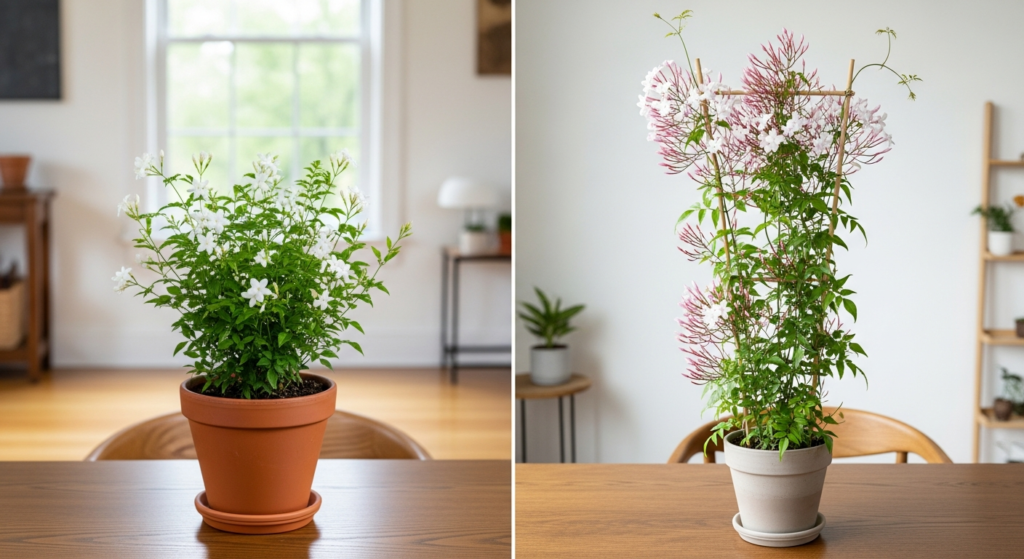
Not all jasmine plants work indoors, and picking the wrong type is the fastest way to fail. The term “jasmine” gets used loosely—some fragrant plants called jasmine aren’t true jasmine at all. Real jasmine belongs to the Jasminum genus, but even within true jasmines, growth habits vary wildly.
Dwarf varieties stay compact naturally, typically reaching 2-4 feet tall. These work well in smaller spaces or on tabletops. They need less aggressive pruning and simpler support structures.
Vining varieties are vigorous climbers that can reach 10-20 feet if left unchecked. They produce more flowers overall but demand regular training, sturdy supports, and consistent pruning to keep them manageable indoors.
Here’s a comparison of the most common indoor-suitable types:
| Variety | Growth Type | Height Potential | Fragrance Strength | Bloom Season | Cold Requirement |
|---|---|---|---|---|---|
| Jasminum sambac (Arabian) | Dwarf/Semi-vine | 3-6 feet | Strong | Year-round | None |
| Jasminum polyanthum (Pink) | Aggressive vine | 10-20 feet | Very strong | Winter-spring | Yes (40-50°F) |
| Jasminum nitidum (Star) | Moderate vine | 6-10 feet | Moderate | Spring-summer | Minimal |
| Jasminum officinale (Common) | Aggressive vine | 15+ feet | Strong | Summer | Yes (35-45°F) |
| Jasminum humile (Italian) | Compact shrub | 4-7 feet | Light | Summer | None |
Jasminum sambac stands out for indoor growing because it blooms without cold treatment and stays relatively manageable. The ‘Grand Duke of Tuscany’ and ‘Maid of Orleans’ cultivars are particularly well-suited to container life. I keep a ‘Maid of Orleans’ in my bedroom specifically because it flowers consistently without the dormancy juggling act.
Jasminum polyanthum offers the most intense fragrance and masses of pink-tinged white flowers, but it’s also the trickiest. Without 4-6 weeks of temperatures between 40-50°F in late fall, it won’t set flower buds. Many people bring this variety home, keep it in a warm house year-round, and wonder why it grows like crazy but never blooms.
Dwarf vs. Vining Varieties: Which Fits Your Space
The choice between dwarf and vining types determines everything else—your pot size, support structure, pruning frequency, and how much time you’ll spend managing growth.
Dwarf varieties work best when:
- Your space is limited (small apartments, dorm rooms, offices)
- You want flowers without major maintenance
- You prefer plants on furniture rather than floor-standing structures
- You’re new to jasmine growing
- You can’t provide winter cold periods
Vining varieties make sense when:
- You have vertical space to use (walls, windows, room corners)
- You want maximum flower production
- You enjoy the look of trained, climbing plants
- You can commit to regular pruning and training
- You can provide appropriate dormancy conditions (for varieties that need it)
I learned this distinction the hard way. My first J. polyanthum went into a 6-inch pot on a small trellis. Within six months, it had outgrown three successive pots and toppled two support structures. I eventually moved it to a 16-inch floor pot with a 6-foot trellis, where it finally had room to grow properly.
One key point that often gets overlooked: vining varieties typically produce more flowers because they have more growing points along their length. Each vine segment can develop flower clusters, while dwarf types flower mainly at branch tips. If your goal is maximum fragrance, a well-trained vining variety will outperform a dwarf—but you’re trading that extra bloom power for extra work.
Setting Up Support Structures
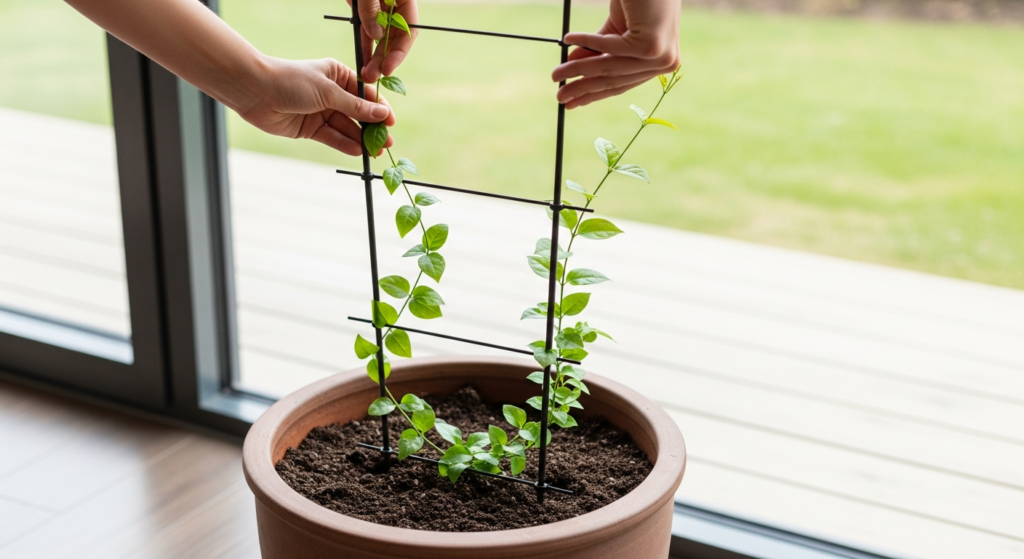
Support structures need to be in place before your jasmine really takes off. Installing them after the fact means wrestling with established growth, and you’ll likely damage stems or flowers in the process.
Support Options by Plant Size
| Support Type | Best For | Stability Level | Price Range | Installation Difficulty |
|---|---|---|---|---|
| Bamboo stakes (18-24″) | Small dwarf types | Low | $5-10 | Easy |
| Wire cage/obelisk | Medium dwarf/compact vines | Medium | $15-30 | Easy |
| Wall trellis | Vining types near walls | High | $20-60 | Moderate |
| Freestanding trellis | Floor-pot vining types | High | $30-80 | Moderate |
| Tension pole system | Aggressive vines | Very high | $40-100 | Moderate-Hard |
| Wire/string grid | Custom spaces, windows | Variable | $10-40 | Moderate |
For dwarf varieties like J. sambac, a simple bamboo tripod or small wire cage works fine. Push three 2-foot bamboo stakes into the soil around the pot’s edge, tie them together at the top, and you have enough support for the plant’s modest climbing tendency.
Vining types need something substantial. I use freestanding trellises for my floor plants—wooden or metal frames that sit in or behind the pot. The trellis should be at least as tall as you want the plant to grow, with horizontal crossbars every 8-12 inches. Jasmine vines wrap around supports as they grow, but they need those horizontal elements to grab onto.
One setup that’s worked surprisingly well: tension poles with horizontal wires. These adjustable poles fit between floor and ceiling, and you can string wire or fishing line horizontally between two poles to create a custom grid. This works especially well near windows where you want the jasmine to frame the view without blocking light.
Installation tips:
- Secure supports before the plant needs them (proactive, not reactive)
- Make sure floor-standing structures are weighted or secured—a fully grown jasmine with flowers becomes surprisingly heavy when watered
- Leave 2-3 inches between the support and the pot edge so you can water without obstruction
- For wall-mounted trellises, use proper wall anchors rated for at least 20 pounds
A mistake I made early on: using decorative but flimsy supports because they looked nice. A blooming J. polyanthum in a 14-inch pot weighs around 25-30 pounds when the soil is wet. That decorative wire trellis bent under the weight during a particularly heavy flowering period, and I spent an afternoon carefully repositioning everything.
Training Techniques for Vining Jasmine
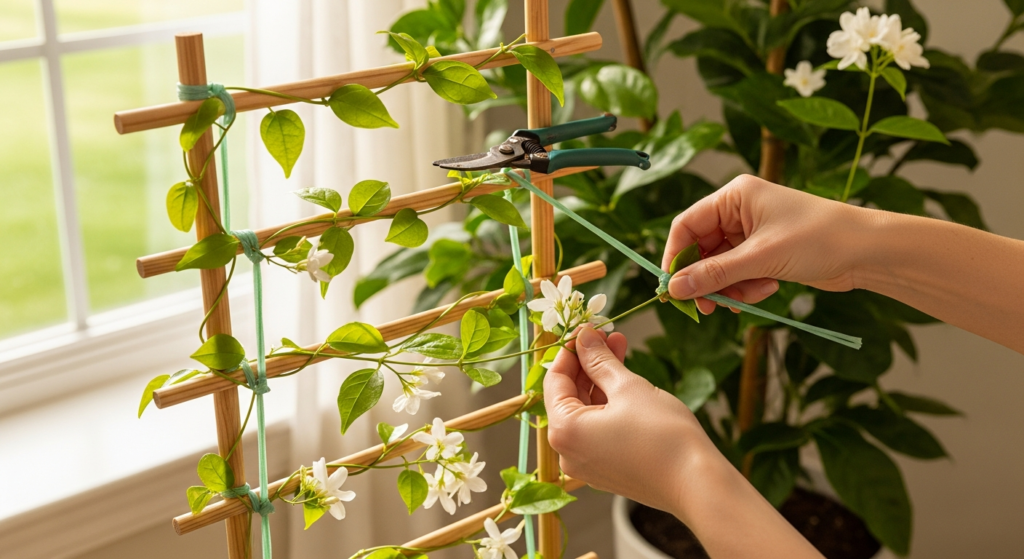
Training jasmine vines isn’t difficult, but it requires regular attention. These plants grow fast during their active season—sometimes 2-3 inches per week—so weekly check-ins keep them under control.
Basic Training Steps
Start early. When new growth reaches 6-8 inches, begin directing it toward your support. Young, flexible stems are easy to position; older, woody stems resist and may crack if forced.
Wrap clockwise. Most jasmine vines naturally twine clockwise (when viewed from above). Working with this tendency rather than against it makes training easier and reduces stem stress.
Space evenly. Don’t let all the vines climb the same path. Distribute them across your trellis or support so each vine gets light and air. Overcrowded growth in the center leads to poor flowering and increased pest problems.
Secure loosely. Use soft plant ties, twist ties, or strips of fabric to attach vines to the support. Don’t cinch tightly—stems expand as they grow, and tight ties create constriction points that damage the plant.
Check weekly. During active growth (spring and summer), new vine tips can shoot off in random directions quickly. A weekly inspection lets you redirect growth before it becomes unmanageable.
I spend about 10 minutes per week during growing season just tucking and tying new growth on my vining jasmine. This small time investment prevents the hours-long pruning sessions that become necessary when you ignore the plant for a month.
Training for Maximum Flowers
Here’s something that took me years to understand: how you train your jasmine directly affects bloom quantity. Flower buds form on specific types of growth depending on the variety, and your training approach should encourage that growth type.
Jasminum sambac flowers on new growth. This means the more new tips you encourage, the more flowers you get. Training for this variety focuses on creating a bushy, multi-branched structure with lots of growing points.
Jasminum polyanthum flowers on mature wood from the previous season. For this type, you want longer, established vines that have had time to develop flower buds. Training focuses on horizontal growth and preventing excessive new vertical shoots.
Horizontal training increases flowers. When you train vines horizontally or at a diagonal instead of straight up, the plant produces more lateral shoots along the vine’s length. Each of those shoots becomes a potential flowering point. I train my J. polyanthum vines horizontally across the bottom third of the trellis, then allow vertical growth above that. This creates a dense flowering zone at eye level where I can best enjoy the blooms.
Pinching for Bushiness
Pinching—removing the growing tip of a stem—is your most powerful tool for controlling jasmine shape and encouraging fuller growth. It works because removing the tip breaks apical dominance (the tendency for the main shoot to suppress side growth) and stimulates dormant buds along the stem to activate.
When and How to Pinch
Timing matters. Pinch during active growth, typically spring through summer. Don’t pinch in fall or winter when the plant is slowing down, especially if your variety needs a cold period for flowering.
Where to cut. Locate a leaf node (the bump on the stem where leaves emerge) and pinch or cut just above it, about 1/4 inch above the node. New growth will sprout from buds at that node.
How often. For dwarf varieties you want bushy, pinch new growth when it reaches 4-6 inches. For vining varieties, pinch when training a new vine and you want it to branch, or when you’re trying to fill in a sparse area.
Here’s the pinching schedule I use:
| Plant Type | Frequency | Purpose | Stop Before |
|---|---|---|---|
| J. sambac dwarf | Every 4-6 weeks in spring/summer | Maintain compact shape | Mid-August |
| J. sambac allowed to vine | Monthly | Encourage branching | Mid-August |
| J. polyanthum | Early spring only | Shape after bloom | June |
| J. nitidum | Every 6-8 weeks | Control size, promote branches | Late July |
Stop pinching 6-8 weeks before you expect flower buds to form. For varieties that bloom in winter or early spring (J. polyanthum), that means stopping in late summer. For continuous bloomers (J. sambac), you can pinch year-round but I stop in late summer to let the plant put energy into flowering through fall and winter.
Pinching technique: Use your fingernails or clean scissors. Grab the stem tip between your thumb and forefinger and snap it off cleanly, or make a clean cut with scissors. Don’t tear or rip—clean cuts heal faster and are less susceptible to disease.
I got aggressive with pinching on one J. sambac plant specifically to test how bushy I could make it. Every time new growth reached 5 inches from April through July, I pinched it. By August, the plant looked like a dense, rounded shrub rather than anything vine-like, with at least 40-50 growing tips. That same plant produced flowers almost continuously from September through March because every one of those tips generated buds.
Understanding Winter Chill Requirements
This topic causes more confusion and disappointment than almost anything else with jasmine. Several popular varieties—particularly Jasminum polyanthum and J. officinale—need a period of cold temperatures to trigger flower bud formation.
The Science Behind Cold Requirements
These jasmine varieties evolved in regions with cool winters. The cold period signals to the plant that winter is coming, which triggers hormonal changes that initiate flower bud development. Without adequate chilling, the plant continues vegetative growth but won’t set buds.
The required temperatures and duration vary:
| Variety | Temperature Range | Duration Needed | Timing |
|---|---|---|---|
| J. polyanthum | 40-50°F | 4-6 weeks | October-December |
| J. officinale | 35-45°F | 6-8 weeks | November-January |
| J. nitidum | 45-55°F (beneficial but not required) | 3-4 weeks | November-December |
| J. sambac | None needed | N/A | N/A |
Temperature consistency matters more than exact degrees. A location that fluctuates between 35°F and 65°F doesn’t work as well as one that stays steadily between 45-50°F.
Providing Chill Indoors
If you live in a climate with cold winters, this is straightforward: move your jasmine to an unheated garage, enclosed porch, or cool basement that stays within the target range. The space needs some natural light—a window or skylight—because the plant isn’t fully dormant.
For those without naturally cold spaces, you have a few options:
Cool bedroom or spare room: I’ve successfully chilled jasmine in a rarely-used bedroom with the heat vent closed and window cracked. Nighttime temperatures dropped to 45-48°F while daytime hit 55-60°F. Not perfect, but sufficient.
Attached garage with window: If your garage doesn’t freeze, it often provides ideal conditions. Park the jasmine near the window and monitor temperatures. Use a min-max thermometer to track the range.
Between storm door and entry door: This creates a cold buffer zone. Only works with full-glass storm doors that allow light through.
Unheated sunroom or enclosed porch: Ideal if you have one. Full light, protected from rain and snow, but cold enough to trigger dormancy.
The challenge isn’t just reaching the cold temperatures—it’s doing so while still providing enough light. Jasmine won’t flower well even with proper chilling if it’s stored in darkness. I tried chilling one plant in my basement one year (no windows, just fluorescent lights). It got adequate cold but produced sparse, weak blooms because the light quality was so poor.
What Happens Without Chill
Skip the cold requirement, and your jasmine will survive just fine. It’ll grow enthusiastically, produce lots of healthy green leaves, and look beautiful. But it won’t flower, or flowering will be minimal and sporadic.
I kept a J. polyanthum in my 68°F house year-round for its first two years. Zero flowers. Lush, gorgeous foliage climbing everywhere, but not a single bloom. Year three, I put it in the garage for six weeks in November-December. That spring, it exploded with so many flowers I could smell it from the driveway when I came home.
Managing Aggressive Growth
Vining jasmine varieties can quickly become overwhelming if you don’t stay ahead of them. The key is combining training, pruning, and knowing when to let the plant grow versus when to cut it back.
Growth Rates to Expect
During peak growing season (late spring through summer), expect these approximate growth rates:
- J. sambac: 1-2 inches per week
- J. polyanthum: 3-4 inches per week
- J. officinale: 2-3 inches per week
- J. nitidum: 1.5-2.5 inches per week
Jasminum polyanthum is genuinely aggressive. I measured one vine that grew 18 inches in a single month during June. This rapid growth is partly why the variety flowers so prolifically—it’s just vigorous in everything it does.
Pruning Strategies
After flowering: The best time for major pruning is right after the main flowering period ends. For winter-blooming types, that’s early spring. For summer bloomers, that’s late summer or early fall. The plant has time to recover and put on new growth before the next bloom cycle.
Remove dead and weak growth: Start any pruning session by cutting out dead stems, diseased parts, and thin, weak vines that aren’t contributing to the plant’s structure. This opens up the interior and redirects energy to healthy growth.
Shorten long vines: Cut back vines that have outgrown your space by up to one-third. Make cuts just above a leaf node where you want new growth to emerge.
Thin crowded areas: If vines are tangled together or crossing repeatedly, remove the weaker ones entirely. Good air circulation through the plant reduces pest problems and ensures all parts get light.
My pruning approach for a floor-standing J. polyanthum: Right after spring flowering ends (usually April), I cut the plant back by about 30%. I identify the framework of main vines I want to keep—usually 6-8 strong vines distributed around the trellis—and remove everything else at the base. Then I shorten those main vines to about 2/3 their length. This feels drastic, but by August the plant has regrown completely and fills the trellis again.
Root Pruning for Container Control
Eventually, aggressive jasmine varieties outgrow their pots. You’ll notice roots circling densely at the soil surface or growing out drainage holes. At this point, you can either move up to a larger pot (which encourages more growth) or root prune to keep the plant in its current container.
Root pruning steps:
- Remove the plant from its pot in early spring
- Use a clean, sharp knife to slice off the outer 1-2 inches of the root ball on all sides and bottom
- Trim any circling or damaged roots
- Repot in the same container with fresh potting soil
- Water thoroughly and keep in bright indirect light for 2 weeks while roots recover
This resets the root system and can maintain a jasmine in the same pot for years. I’ve kept one J. sambac in a 12-inch pot for five years using root pruning every 18-24 months.
Creating the Right Growing Environment
Training and pruning matter, but they won’t compensate for poor growing conditions. Jasmine needs specific light, water, and humidity to thrive indoors and produce flowers.
Light Requirements
Most jasmine varieties need bright light to flower well. Place them within 3 feet of a south or west-facing window, or supplement with grow lights if natural light is limited.
| Variety | Minimum Light | Ideal Light | Signs of Insufficient Light |
|---|---|---|---|
| J. sambac | 4 hours direct sun | 6+ hours direct/bright indirect | Sparse flowering, leggy growth |
| J. polyanthum | 4-6 hours direct sun | 6-8 hours direct sun | No flower buds, pale leaves |
| J. officinale | 6 hours direct sun | 8+ hours direct/bright | No flowering, weak stems |
| J. nitidum | 3-4 hours direct sun | 5-6 hours direct/bright | Reduced flowering |
During winter, light intensity drops significantly even in the same window location. If your jasmine is borderline in summer, it may need supplemental lighting or a move to a brighter spot in winter.
I use full-spectrum LED grow lights for my jasmine from November through February, even though they’re near a south window. The lights run 4-6 hours per day to supplement weak winter sun, and flowering noticeably improves compared to years when I didn’t use supplemental light.
Watering and Humidity
Jasmine prefers consistently moist soil but will rot if waterlogged. Water when the top inch of soil feels dry, providing enough that water runs out the drainage holes.
During active growth and flowering, check soil every 2-3 days. During slower growth or dormancy, check weekly. Vining varieties in large pots need more water than dwarf types in small pots simply because there’s more root mass and foliage losing moisture.
Humidity helps but isn’t critical for most varieties. Aim for 40-50% relative humidity if possible. I group my jasmine with other tropical plants to create a slightly more humid microclimate, but I don’t run a humidifier specifically for them.
Fertilizing for Flowers
Flowers require phosphorus, so choose a fertilizer with a higher middle number (NPK ratio). I use a 5-10-5 liquid fertilizer diluted to half strength every 2 weeks during active growth.
Stop fertilizing during the cold period if your variety needs one. Resume when new growth appears after dormancy breaks.
A common mistake is over-fertilizing with high-nitrogen fertilizers, which push leaf growth at the expense of flowers. If your jasmine is growing vigorously but not blooming (and you’ve addressed light and cold requirements), check your fertilizer ratio. Switch to a bloom-focused formula with more phosphorus.
Troubleshooting Common Problems
Even with proper care, issues come up. Here are the problems I’ve encountered repeatedly and what actually worked to fix them.
No Flowers Despite Healthy Growth
Possible causes:
- Insufficient light (most common)
- Missing cold requirement (for varieties that need it)
- High-nitrogen fertilizer
- Over-pinching late in the season
- Plant is too young (jasmine typically starts flowering at 2-3 years old)
Solutions: Track light hours using a light meter app. Provide required chilling period. Switch to bloom fertilizer. Stop pinching 6-8 weeks before expected bloom time.
Yellowing Leaves
Possible causes:
- Overwatering (if leaves yellow and fall from base up)
- Underwatering (if leaves yellow at tips and edges first)
- Nutrient deficiency (if yellowing is uniform across plant)
- Natural aging (older leaves at the base)
Solutions: Adjust watering frequency based on symptoms. Feed with balanced fertilizer if you haven’t fertilized recently. Some leaf drop is normal—don’t panic unless it’s excessive.
Leggy, Sparse Growth
Causes: Insufficient light or not enough pinching.
Solutions: Move to brighter location or add grow lights. Start aggressive pinching to force branching.
I had one J. sambac that stretched terribly in a north-facing window despite being healthy otherwise. After moving it to an east-facing window and pinching every new shoot for three months, it transformed into a dense, bushy plant.
Pest Problems
Spider mites, aphids, and whiteflies occasionally attack indoor jasmine. Inspect regularly, especially on new growth and under leaves.
For minor infestations, spray with water to dislodge pests. For heavier problems, use insecticidal soap or neem oil, following label directions. I’ve had good success with neem oil applied every 5-7 days for three applications.
Seasonal Care Calendar
This schedule provides a framework, but adjust based on your specific variety and local conditions:
| Season | Key Tasks | Focus |
|---|---|---|
| Spring | Resume fertilizing, increase watering, train new growth, prune after flowering (winter bloomers) | Active growth begins |
| Summer | Regular training and pinching, consistent watering, monitor for pests | Peak growth season |
| Fall | Reduce fertilizing, begin cold treatment if needed, stop pinching | Prepare for dormancy |
| Winter | Minimal watering, no fertilizer during cold treatment, monitor temperature | Dormancy/chilling, flowering for some varieties |
Frequently Asked Questions
Can I grow vining jasmine without a support structure?
Technically yes, but it won’t look good or flower well. Without support, vining jasmine becomes a tangled mess on the floor or spreads across furniture. The vines need vertical orientation and good light exposure to produce flowers. If you don’t want to use supports, choose a dwarf variety that naturally stays compact.
How long before my jasmine flowers?
Most jasmine plants start flowering at 2-3 years old from cuttings. If you bought an established plant, it may flower within months if conditions are right. Jasminum sambac tends to flower younger than vining types. Be patient—a year of establishing roots and structure before flowering is normal.
My jasmine flowered once but hasn’t bloomed again. What happened?
For varieties requiring cold treatment (J. polyanthum especially), this usually means the plant didn’t get adequate chilling the second year. Other possibilities include insufficient light, incorrect pruning that removed flowering wood, or high-nitrogen fertilizer. Review your care routine against the specific requirements for your variety.
Can I keep jasmine in the same pot forever, or does it need repotting?
Vining varieties eventually need larger pots or root pruning to stay healthy. Dwarf types can remain in the same pot for many years with annual top-dressing (removing the top inch of soil and replacing with fresh). Plan to root prune or upsize pots every 2-3 years for actively growing plants. Signs you need to repot include roots growing from drainage holes, water running straight through without absorbing, or dramatically slowed growth despite good care.
Conclusion
Growing fragrant jasmine indoors comes down to matching the right variety to your space and providing what that specific type needs. Dwarf varieties like Jasminum sambac offer continuous blooms without major fuss, making them ideal for beginners or smaller spaces. Vining types require more effort with training, support, and often winter chilling, but reward you with abundant flowers and that incredible fragrance.
Start with a realistic assessment of your space, light availability, and willingness to provide cold treatment. Choose your variety accordingly. Set up appropriate supports from the beginning. Train and pinch regularly during the growing season to keep growth under control and encourage flowering. For varieties needing winter chill, prioritize that requirement—it’s the difference between a plant that blooms and one that doesn’t.
The effort you put into proper training and care multiplies over time as your jasmine matures and establishes. A well-trained three-year-old jasmine can fill an entire room with fragrance during bloom periods, creating an experience that no store-bought air freshener can match.
What’s your biggest challenge with growing jasmine indoors—getting it to flower, managing aggressive growth, or something else entirely? Share your experience in the comments below.