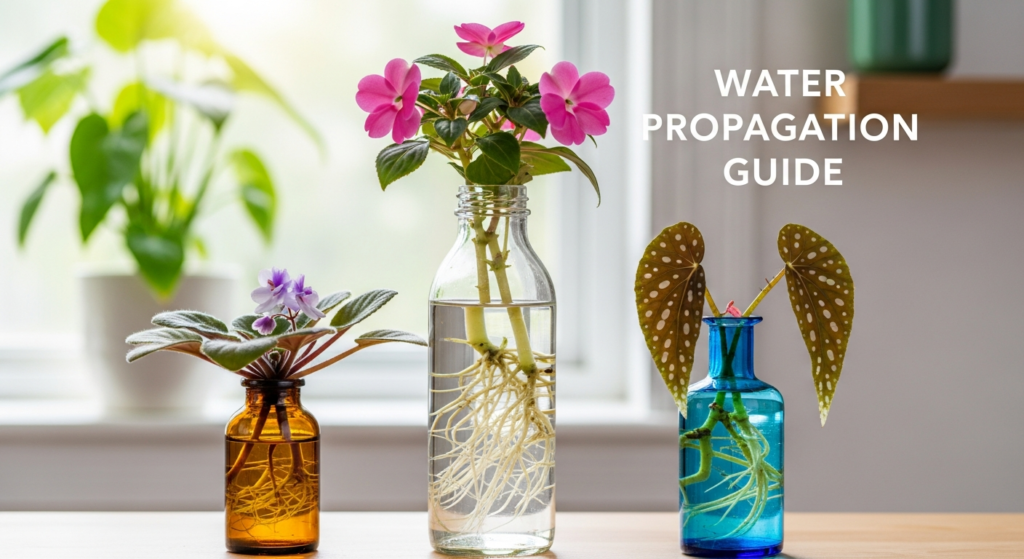

Growing plants in water seems almost magical when you first try it. You snip a stem, drop it in a glass jar, and within days or weeks, roots start threading through the water like delicate white fingers. No soil, no mess—just a clean way to multiply your favorite flowering plants while creating living decorations for your home.
But not every flowering plant takes to water propagation. Some rot within days. Others root beautifully but struggle when you eventually move them to soil. After years of experimenting with water propagation, I’ve learned which blooming plants actually thrive in water, how to keep that water clean instead of turning into a murky soup, and when you actually need rooting hormone versus when it’s just extra expense.
If you’ve ever looked at your African violet or begonia and wondered whether you could create more plants without buying potting mix or dealing with soil under your fingernails, this guide will walk you through everything. You’ll learn which flowering houseplants root easily in water, how to prevent the algae problem that ruins most attempts, and how to choose containers that look intentional rather than like you’re just reusing old pasta sauce jars.
I’m Darcey Wren, and I’ve been growing and writing about indoor flowering houseplants for several years now. My interest in water propagation started when a friend gave me a pothos cutting in a bottle, and I became curious about whether flowering plants could grow the same way. Through trial and error—plenty of failed cuttings that turned to mush—I’ve figured out which techniques actually work. I share what I’ve learned because there’s something satisfying about passing along practical knowledge that helps other people succeed with their plants.
Which Flowering Houseplants Root Successfully in Water
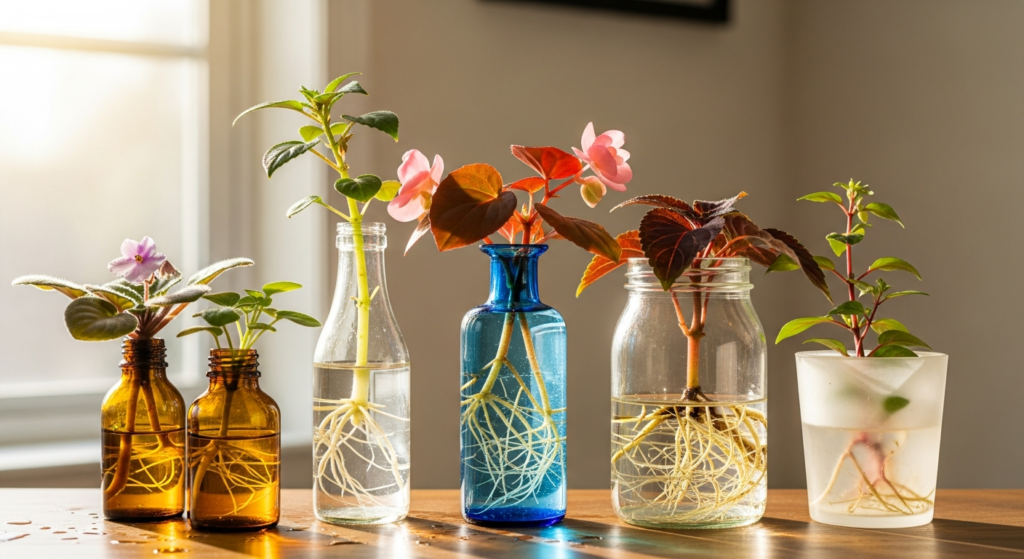
Not all flowering plants cooperate with water propagation. Some have woody stems that rot before roots form. Others need specific conditions that plain water can’t provide. But several popular flowering houseplants root readily in water and will even bloom while sitting in a vase.
Easy Water-Rooting Bloomers
African violets root surprisingly well in water if you take leaf cuttings rather than stem cuttings. The leaf stem develops roots within two to three weeks. I’ve rooted dozens of African violet leaves in small bottles lined up on my kitchen windowsill.
Impatiens—both standard and New Guinea types—root so easily in water that they almost feel foolproof. Cut a 4-inch stem below a leaf node, remove the bottom leaves, and you’ll see roots in about a week. These plants will even flower while they’re still in water, though the blooms tend to be smaller.
Begonias are hit-or-miss depending on the type. Wax begonias and angel wing begonias root well in water. Rex begonias can work but are trickier. Tuberous begonias generally fail in my experience—they rot more often than they root.
Coleus technically isn’t grown for flowers, but it does bloom, and it roots faster in water than almost anything else. You’ll see roots within three to five days.
Fuschia cuttings root in water within two weeks. The key is taking cuttings from new growth rather than old, woody stems.
| Plant Type | Rooting Time | Success Rate | Special Notes |
|---|---|---|---|
| African Violet | 2-3 weeks | High | Use leaf cuttings, not stems |
| Impatiens | 7-10 days | Very High | Will bloom in water |
| Wax Begonia | 10-14 days | High | Keep out of direct sun |
| Angel Wing Begonia | 2-3 weeks | Moderate | Needs warmth |
| Coleus | 3-5 days | Very High | Fastest rooter |
| Fuchsia | 10-14 days | Moderate | Take soft growth only |
Flowers That Don’t Root Well in Water
Geraniums usually rot in water. They need well-draining conditions and don’t appreciate having their stems constantly submerged.
Roses can technically root in water, but the success rate is low. They’re much better rooted in moist sand or perlite.
Most succulents and cacti that flower—like Christmas cactus or Kalanchoe—rot quickly in water. Their stems aren’t designed for constant moisture.
Orchids don’t propagate from cuttings at all, so water rooting isn’t an option.
Understanding Rooting Hormone: When You Need It and When You Don’t
Rooting hormone is a powder or liquid containing auxins—plant hormones that stimulate root growth. Many gardening guides treat it like a required supply, but for water propagation of flowering houseplants, it’s often unnecessary.
Plants That Root Fine Without Hormone
Most soft-stemmed flowering houseplants don’t need rooting hormone when propagated in water. The water itself provides enough moisture and the plant’s natural auxins concentrate at the cut end, triggering root development.
I’ve rooted hundreds of impatiens, coleus, and begonia cuttings without ever using rooting hormone. The success rate is essentially the same whether I use it or not.
African violets root from leaf cuttings without any hormone treatment. The leaf petiole naturally develops roots when kept in water.
When Rooting Hormone Actually Helps
Rooting hormone becomes useful for plants with semi-woody stems or slower root development. Fuchsia benefits from a light dusting of rooting powder before going into water. The hormone speeds up the process and increases the percentage of cuttings that successfully root.
Roses—if you insist on trying water propagation despite the low odds—definitely benefit from rooting hormone.
Gardenia cuttings, which are notoriously difficult, have a better success rate with hormone treatment, though even then they’re challenging in plain water.
How to Use Rooting Hormone with Water Propagation
If you decide to use rooting hormone, the process is simple. Dip the cut end of your stem about half an inch into the powder, tap off the excess, then place it in water. The hormone will dissolve gradually into the water.
Don’t use too much. A light coating is sufficient. Caking on powder doesn’t improve results and can actually inhibit rooting.
For liquid rooting hormone, follow the package dilution instructions, then let your cutting sit in the hormone solution for the recommended time before transferring to plain water.
| Scenario | Rooting Hormone Needed? | Why |
|---|---|---|
| Soft-stemmed plants (impatiens, coleus) | No | Natural auxins sufficient |
| African violet leaves | No | Roots form easily without help |
| Semi-woody stems (fuchsia) | Optional but helpful | Speeds process, improves success |
| Difficult plants (gardenia, rose) | Yes | Increases low success rates |
| First-time propagators | No | Learn basic process first |
Preventing Algae: Keeping Your Water Display Clean
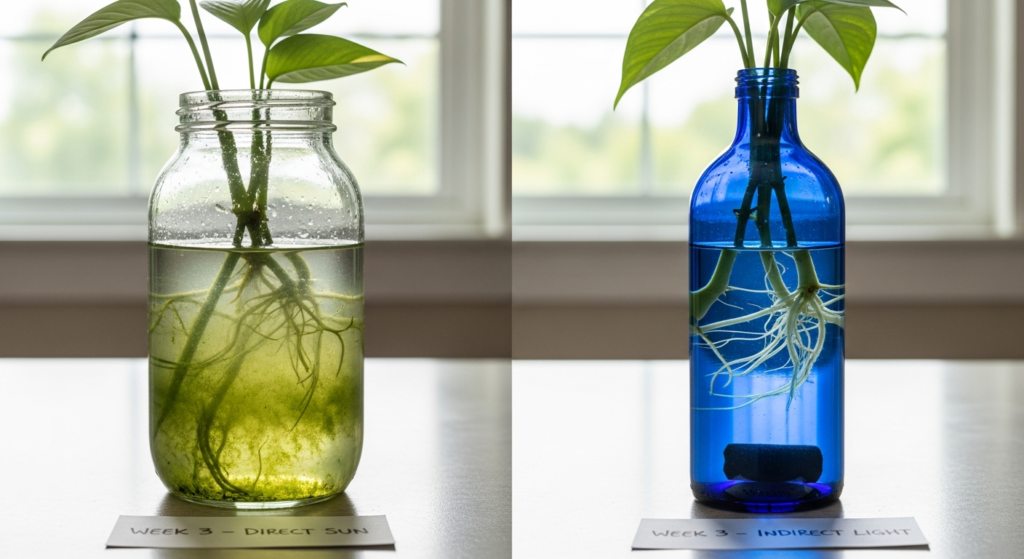
Algae is the main problem that turns water propagation from attractive to disgusting. That green film coating the inside of your vase and making the water cloudy doesn’t harm the plant directly, but it blocks light, looks terrible, and can harbor bacteria as it decomposes.
Why Algae Grows
Algae needs three things: light, water, and nutrients. When you put a cutting in a clear glass container on a sunny windowsill, you’re providing perfect conditions. The nutrients come from the plant itself as cells break down at the cut surface.
Choosing the Right Container
Colored or opaque containers dramatically reduce algae growth. Dark blue, amber, or frosted glass blocks enough light to slow algae development significantly.
If you want to see the roots—which is half the appeal of water propagation—look for containers with narrow necks. A bottle with a 1-inch opening lets you see down into the water to check root development while limiting the light exposure compared to a wide-mouth jar.
I keep a collection of small blue glass bottles specifically for water propagation. They’re attractive enough to leave sitting out, and the colored glass keeps algae under control.
Water Change Schedule
Changing the water regularly is the single most effective algae prevention method. Fresh water means fewer nutrients for algae and removes any algae spores before they can establish colonies.
For the first two weeks, when the cutting is most vulnerable, change the water every two to three days. After roots develop, you can stretch it to once a week.
Use room-temperature water, not cold tap water straight from the faucet. Cold water can shock the developing roots.
Adding Activated Charcoal
A small piece of activated charcoal—about the size of a marble—dropped into the water helps keep it clear. The charcoal absorbs impurities and has mild antibacterial properties.
You can buy activated charcoal marketed for aquariums or terrariums. One piece lasts for several months before needing replacement.
Don’t confuse this with charcoal briquettes for grilling. Those contain additives and won’t work.
Light Management
Position your water propagation display where it gets bright, indirect light rather than direct sun. This gives the cutting enough light to maintain the leaves while reducing conditions favorable to algae.
A north-facing window is ideal. East-facing works too, with morning sun being gentler than afternoon sun.
If you only have south or west windows, place the containers a few feet back from the glass or behind a sheer curtain.
Transitioning Rooted Cuttings from Water to Soil
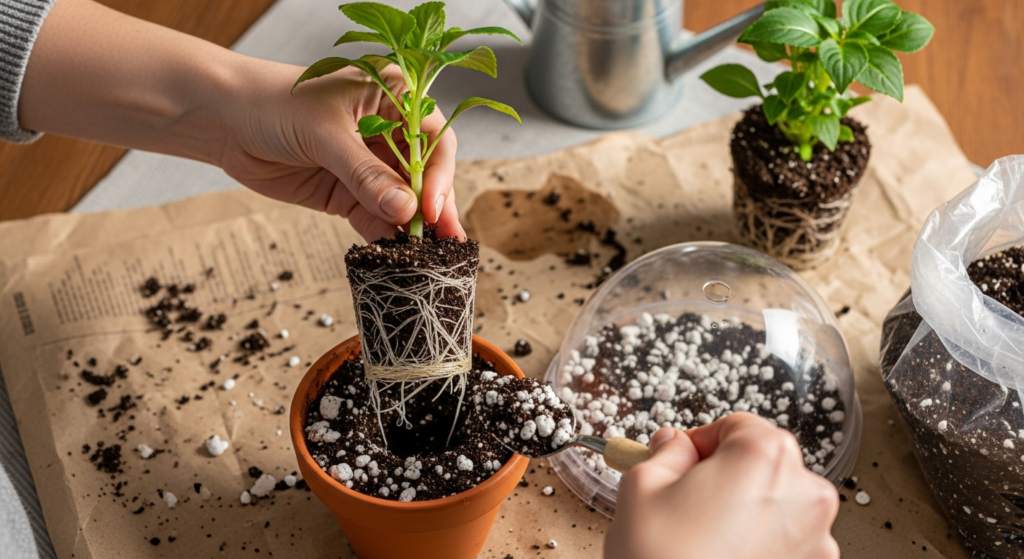
Roots that develop in water are structurally different from soil roots. They’re thicker, fewer in number, and adapted to an environment with constant moisture and no soil particles. This means transitioning to soil requires some adjustment time.
When to Make the Move
The right time to transition is when roots are 2 to 3 inches long. Shorter than that, and the cutting hasn’t developed enough root mass to support itself in soil. Longer than 4 inches, and the roots become so adapted to water that they struggle more with the transition.
I’ve let impatiens cuttings stay in water for months, developing 6-inch root systems, then watched them wilt and struggle when planted in soil. Cuttings moved to soil at the 2 to 3-inch root stage adapt much more easily.
Preparing the Cutting
Before planting, let the cutting sit out of water for 30 minutes to an hour. This slight drying period helps the roots adjust to not being constantly submerged.
Don’t let it wilt—just let excess water drain and the roots air out slightly.
Choosing the Right Soil Mix
Use a light, well-draining potting mix. Heavy soil that stays wet will rot the water roots before they can adapt.
I mix standard potting soil with perlite or coarse sand—about two parts soil to one part perlite. This creates drainage while still holding some moisture.
For African violets, use an African violet-specific mix that’s even lighter and fluffier.
Planting Process
Choose a small pot—4 inches or less in diameter. Large pots hold too much soil and water, overwhelming the small root system.
Make a hole in the soil deep enough for the roots without bending or breaking them. Water roots are more fragile than soil roots.
Place the cutting in the hole and gently fill in soil around the roots. Don’t pack it down hard. Lightly firm the soil so the cutting stands upright.
Water thoroughly until water drains from the bottom of the pot.
The Critical First Week
Water roots need higher humidity and more consistent moisture during the first week in soil. I cover newly planted cuttings with a clear plastic bag or dome for three to five days. This creates a humid microenvironment that prevents wilting while the roots adjust.
Remove the cover gradually—first for a few hours a day, then half a day, then completely.
Water whenever the top half-inch of soil feels dry. Check daily. The cutting can’t pull water efficiently yet with its water-adapted roots, so the soil needs to stay consistently moist but not soggy.
| Transition Stage | What to Do | Why It Matters |
|---|---|---|
| Root length 2-3 inches | Move to soil now | Optimal adaptation period |
| Pre-planting | Air dry 30-60 minutes | Reduces shock |
| Soil choice | Light, fast-draining mix | Prevents root rot |
| Pot size | 4 inches or smaller | Matches root system |
| First week | Cover with plastic dome | Maintains humidity |
| First two weeks | Keep soil moist | Roots can’t pull water efficiently yet |
Long-Term Water Growing
Some people skip the soil transition entirely and keep flowering plants growing in water permanently. Impatiens will live in water for months, blooming repeatedly. African violets can stay in water long-term if you add a few drops of liquid fertilizer every few weeks.
The downside is that plants in water alone don’t grow as large or bloom as abundantly as plants in soil. They’re fine as temporary displays but won’t reach their full potential.
Selecting Decorative Vases for Floating Flower Displays
The container matters more than you might think. A beautiful vase turns a propagation experiment into intentional decor. A boring glass makes it look like you forgot to finish planting something.
Size Considerations
For single cuttings, look for containers with openings between 0.5 and 1.5 inches in diameter. The cutting should fit through the opening but not fall through. Bottles with narrow necks naturally support the cutting at the right height.
Avoid openings wider than 2 inches unless you’re rooting multiple cuttings together. Wide mouths let in too much light, encouraging algae, and don’t provide support for the stem.
Height should be 4 to 8 inches for most flowering houseplant cuttings. Taller containers work for longer cuttings like fuchsia. Shorter bottles suit compact plants like begonias.
Material Options
Glass remains the most popular choice because you can watch roots develop. Clear glass shows everything, which is exciting at first but reveals every bit of algae.
Colored glass—especially blue, green, or amber—reduces algae while still letting you glimpse the roots. This is my preferred option.
Ceramic containers with openings at the top work if you don’t care about seeing the roots. They provide excellent light blocking and come in countless decorative styles.
Vintage bottles—medicine bottles, milk bottles, old soda bottles—add character. Check antique shops or estate sales. Many have narrow necks perfect for supporting cuttings.
Style and Placement
A cluster of small bottles with different cuttings creates more visual interest than one large vase. Group three to five bottles of varying heights on a windowsill or shelf.
Match the container style to your room decor. Modern minimalist spaces look good with simple clear cylinders or test tube-style vases. Traditional rooms suit vintage bottles or colored glass.
Consider buying propagation station sets—wooden or metal racks that hold multiple small vases or test tubes. These create an organized, intentional look rather than a random collection of bottles.
Budget-Friendly Options
Small glass spice jars work well and cost almost nothing. Remove the labels and lids.
Yogurt jars, especially the individual serving size, have the right proportions for many cuttings. They’re free if you eat yogurt anyway.
Old perfume bottles—the decorative kind from discount stores—often have perfect narrow necks. Once empty, clean them thoroughly and repurpose them.
Thrift stores stock endless vases, bottles, and small containers for a dollar or two each.
| Container Type | Pros | Cons | Best For |
|---|---|---|---|
| Clear glass | See root development | Algae growth | Short-term displays |
| Colored glass | Reduces algae, decorative | Can’t see roots clearly | Long-term displays |
| Narrow-neck bottles | Supports cutting, limits light | Limited to single stems | Individual cuttings |
| Wide-mouth jars | Fits multiple cuttings | Needs support structure | Group displays |
| Ceramic | Blocks all light | Can’t see roots | Decorative focus |
Troubleshooting Common Water Propagation Problems
Even with the right plants and methods, problems happen. Here’s how to fix the most common issues.
Stem Rotting Before Rooting
If your cutting turns brown and mushy at the base before roots form, the problem is usually one of three things.
First, you might be using too much of the stem underwater. Only the bottom inch to inch-and-a-half should be submerged. More than that, and the stem tissue breaks down.
Second, the water might be too warm. Hot water accelerates decomposition. Keep containers away from heat sources and use room-temperature water.
Third, the cutting might have been unhealthy to start with. Take cuttings from vigorous, pest-free growth only.
Roots Growing But Leaves Wilting
This happens when the cutting doesn’t have enough energy reserves. It’s putting resources into root development but can’t sustain the leaves.
Remove some leaves—leave just two or three at the top. This reduces water loss through transpiration and helps the cutting conserve energy.
Make sure the cutting is getting enough light. Without light, it can’t photosynthesize to produce energy.
No Root Development After Several Weeks
Some cuttings are just duds. If you’ve waited three weeks with no sign of roots, the cutting probably won’t succeed. Discard it and try again with a fresh cutting.
Before giving up, check the stem above the water line. Some plants root from nodes above the waterline rather than from the submerged portion. If you see root bumps forming there, adjust the water level to cover those nodes.
Water Turning Smelly
Foul-smelling water means bacterial growth, which will eventually harm the cutting. Change the water immediately and rinse the cutting and container with clean water.
This problem usually means you’re not changing the water frequently enough. In warm weather, bacteria multiply faster, so you may need to change water every two days instead of every three or four days.
Frequently Asked Questions
Can I use tap water for rooting cuttings, or do I need filtered water?
Tap water works fine for most cuttings. If your tap water is heavily chlorinated, let it sit out overnight before using it—the chlorine will evaporate. Very hard water with high mineral content can leave deposits on roots and containers, but it doesn’t usually prevent rooting. I use tap water for 95% of my propagation and haven’t noticed problems compared to the times I’ve used filtered water.
How long can I keep flowering plants growing in water before they must go in soil?
This varies by plant. Impatiens and coleus can live in water for six months or longer if you add diluted liquid fertilizer every few weeks. African violets can stay in water indefinitely with fertilizer. However, most flowering plants will grow larger and bloom better in soil. Water propagation works well for temporary displays or when you’re not ready to pot immediately, but plan to transition within a few months for best results.
Why do my water-rooted cuttings die when I plant them in soil?
The shock of transition is usually the culprit. Water roots are adapted to constant moisture and easy nutrient access. Soil roots need to work harder. To improve success, transition when roots are 2 to 3 inches long, use a light potting mix with good drainage, cover the newly planted cutting with a plastic dome or bag for the first few days, and keep the soil consistently moist for two weeks while the roots adapt. Also, make sure you’re not planting into a pot that’s too large—the excess soil stays too wet.
Can I propagate flowering plants in water during winter, or should I wait for spring?
You can propagate year-round, but success rates are higher in spring and summer when plants are actively growing. Winter cuttings root more slowly because plants are semi-dormant and growth hormones are less active. If you propagate in winter, keep the cuttings in a warm spot—at least 65-70°F. They’ll need more time to develop roots, sometimes twice as long as summer cuttings. I still propagate in winter because I’m impatient, but I expect about half the success rate and much slower root development.
Final Thoughts on Water Propagation
Water propagation gives you a clean, visible way to multiply flowering houseplants without dealing with soil or complicated setups. The technique works well for soft-stemmed bloomers like impatiens, begonias, and African violets, though not every flowering plant cooperates.
You don’t need rooting hormone for most water propagation projects. Fresh water, a decent container, and the right plant species matter more than expensive additives. The real skill comes in preventing algae through smart container choices and regular water changes, then successfully transitioning rooted cuttings to soil when they’re ready.
Start with easy plants like impatiens or coleus to build your confidence. Once you understand how the process works, you can experiment with trickier species. Keep your containers small, change the water often, and don’t wait too long to move rooted cuttings into soil.
Have you tried rooting flowering plants in water? Which plants worked best for you, and did you run into any problems with algae or the transition to soil? Share your experience in the comments—it helps other readers learn what works in different situations.