


You spent hours crafting the perfect parody account, built up followers, and then boom—suspended. No warning. No appeal that works. Just gone.
This happens because Twitter’s (now X’s) impersonation policy has gotten stricter, and most people don’t know the exact rules until it’s too late. The platform treats parody accounts differently than regular profiles, and if you miss even one requirement, your account gets flagged as impersonation—a violation that can result in permanent suspension.
The good news? You can run a successful parody account without getting banned. You just need to follow specific guidelines that X actually enforces. This guide shows you exactly what those rules are, how to set up your account correctly from day one, and what to do if you’ve already been suspended.
Key Takeaways
• Label your account as “Parody” or “Satire” directly in your display name or bio—not just your tweets • Avoid using official verification-style images or exact profile photos from the person you’re parodying • Don’t impersonate in a way that could confuse voters during elections or cause financial harm • Update your disclaimer if X changes its policy requirements (they’ve changed three times since 2022) • Appeal suspensions immediately through X’s help center with clear proof of your parody labeling
What X Considers Impersonation vs. Parody
X draws a hard line between satire and impersonation. Impersonation means pretending to be someone else to deceive people. Parody means making fun of or commenting on a public figure while making it clear you’re not that person.
The problem? X’s automated systems can’t always tell the difference. They look for specific signals in your profile. If those signals aren’t there, you get suspended first and asked questions later.
Here’s what triggers their impersonation filters: using someone’s exact name without disclaimer, copying their profile photo pixel-for-pixel, mimicking verified badges, or posting content that reasonable people might think came from the real person.
X specifically states in their platform manipulation and spam policy that accounts can’t mislead others about their identity. But they also acknowledge parody accounts are allowed—if done correctly.
Required Elements for Every Parody Account
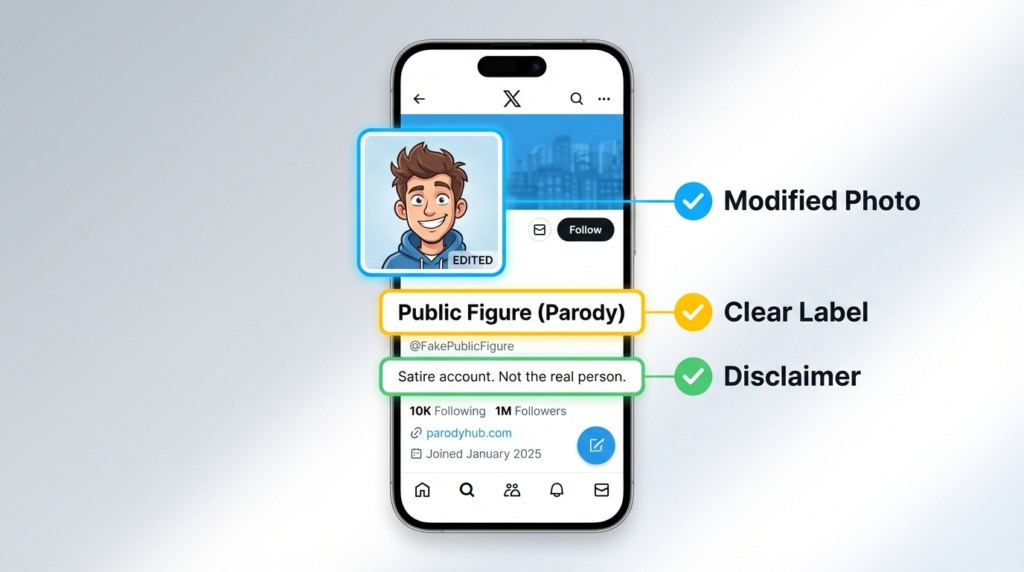
Your account needs three non-negotiable elements to stay live.
Clear Labeling in Your Profile
You must include “Parody,” “Satire,” “Fake,” “Fan,” or similar language. This label needs to appear in one of two places: your display name (the name that shows up in bold) or your bio (the description under your profile photo).
Don’t bury it. Don’t make people guess. The label should be visible the second someone lands on your profile. Here’s what works:
- Display name: “Not Donald Trump (Parody)”
- Display name: “Elon Musk • Parody Account”
- Bio: “Parody account. Not affiliated with [Person Name].”
- Bio: “Satire. This is not the real [Person Name].”
What doesn’t work: putting the disclaimer only in your pinned tweet, only in your header image, or using vague language like “just having fun” or “not serious.”
Modified Profile Photo
You can’t use the exact same photo as the person you’re parodying. X’s systems use image matching to detect this. Even if your bio says “parody,” using an identical photo often triggers automatic suspension.
Your options: use a cartoon version, add a visible “PARODY” watermark across the image, use a similar-but-different photo, or create an obvious edit (like adding a funny hat or changing the background).
Some successful parody accounts use drawings or caricatures instead of photos. This makes the satirical nature immediately obvious.
Differentiated Username (Handle)
Your @username can’t be identical to the real person’s handle. X won’t even let you create an account with an exact match if that username is already taken. But people try to get close with variations like adding underscores, numbers, or extra letters.
This isn’t technically banned, but it increases your suspension risk. Handles like @ElonMusk_ or @RealDonaldTrump2 look like impersonation attempts. Better choices include obvious satire markers: @NotElonMusk, @FakeCEO, @ParodyPolitician.
X’s Enforcement: When Parody Accounts Get Suspended
X doesn’t suspend all rule-breaking accounts equally. They prioritize certain situations.
Election-Related Content
During election periods, X aggressively removes parody accounts of candidates, politicians, and election officials. Even properly labeled accounts sometimes get caught in these sweeps.
Why? Because election misinformation has legal consequences. A parody tweet about voting deadlines or polling locations—even if labeled satire—could suppress turnout. X would rather over-enforce than face regulatory penalties.
If you run a political parody account, expect increased scrutiny from September through November in election years. Some parody account operators temporarily add extra disclaimers during these windows.
Financial Misinformation
Parody accounts that tweet about stocks, crypto, or investment advice face automatic review. A fake Elon Musk tweet saying “Tesla stock will double tomorrow” can move markets, even with a parody label.
X’s policy specifically prohibits using parody accounts to manipulate financial markets. This is one of the few areas where your account can be banned even with proper labeling—if X determines you’re causing measurable financial harm.
Mass Reports
Here’s the unfair part: if enough people report your account, you’ll likely get auto-suspended regardless of your labels. X’s system assumes mass reports indicate a real problem.
This happens most often when a parody tweet goes viral and reaches people who don’t read bios. They see what looks like a real celebrity saying something outrageous, get angry, and report.
Your account usually comes back after review, but you could be locked out for days or weeks while X investigates. There’s no way to prevent this entirely, but keeping your satire obviously absurd (not subtly misleading) helps.
Setting Up Your Account the Right Way
Follow this checklist before you post anything.
| Setup Step | What to Do | Why It Matters |
|---|---|---|
| Display Name | Add “Parody” or “Satire” in the name field | First thing X’s algorithms check |
| Bio | Write a clear disclaimer about not being the real person | Visible on profile without clicking |
| Profile Photo | Use modified, cartoon, or different image | Prevents image-match suspension |
| Header Image | Consider adding “PARODY ACCOUNT” text overlay | Extra visual signal for mobile users |
| Username | Choose handle with satire indicators | Reduces confusion in timeline views |
| First Tweet | Post an explanation of the account’s satirical purpose | Creates searchable proof of intent |
After setup, pin a tweet that explains what the account is. This doesn’t satisfy X’s requirements on its own, but it helps human reviewers if you’re reported.
Common Mistakes That Get Accounts Banned
Assuming Your Content Makes the Satire Obvious
You think your joke about a celebrity eating moon cheese makes it clear you’re not serious. X’s algorithms don’t understand sarcasm. They only scan your profile setup.
Many suspended account owners say “but my tweets were obviously fake!” That doesn’t matter. Profile compliance is what counts.
Changing Your Approach Mid-Account
You start as a clearly labeled parody, gain followers, then remove the disclaimer thinking your audience knows you’re fake. Big mistake.
X continuously scans all accounts, not just new ones. If your profile stops meeting parody requirements at any point, you can get suspended even if you’ve operated for years.
Ignoring Policy Updates
X changes these rules. In 2022, they required parody labels in bios. In 2023, they started accepting display name labels. In 2024, they cracked down on handles that were too similar to real accounts.
If you set up your account three years ago and haven’t checked the current policy, you might not be compliant anymore. Review X’s authenticity policy every few months.
Not Appealing Immediately
When you get suspended, you receive an email with an appeal link. Many people ignore this, thinking it’s useless. Wrong.
Appeals work, especially for properly labeled parody accounts. X makes mistakes. Their automated systems suspend legitimate satire regularly. But you need to appeal quickly—within 7 days is best.
What to Do If You Get Suspended
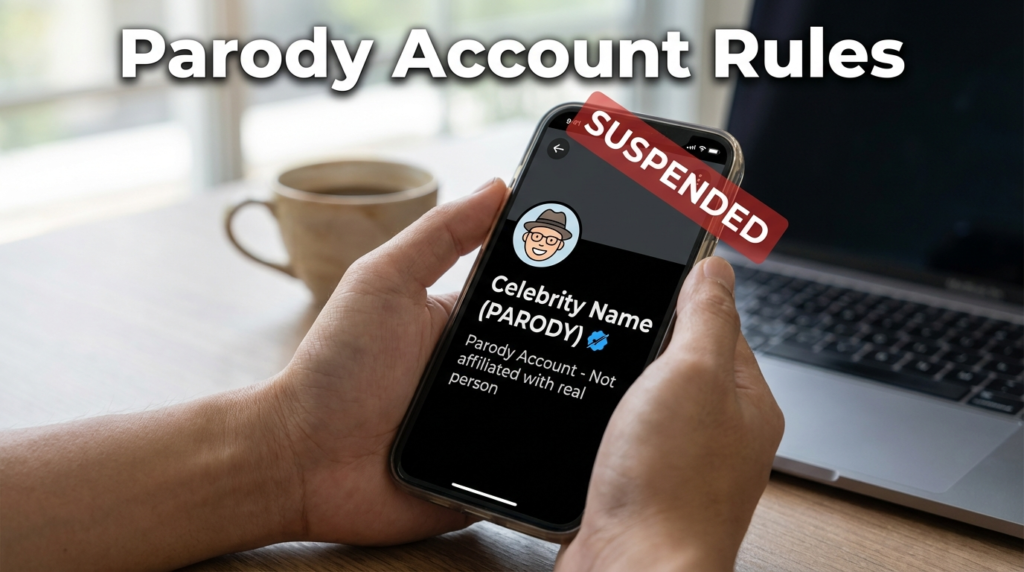
Don’t panic. Most parody account suspensions are reversible if you act fast.
Step 1: Screenshot Your Profile
If you can still access your account before it’s fully locked, take screenshots of your display name, bio, and profile photo showing your parody labels. You’ll need these as evidence.
Can’t access it? Use Google’s cache or the Wayback Machine to find archived versions of your profile showing the labels were present.
Step 2: Submit an Appeal Through X’s Help Center
Log into your suspended account and go to help.x.com. Select “I’ve been suspended” and follow the appeal process. In your appeal:
- State that you run a clearly labeled parody account
- Reference X’s policy allowing satire with proper disclosure
- Attach screenshots proving your compliance
- Explain that your content is obviously satirical commentary
- Request a human review rather than automated decision
Keep it professional. Angry appeals get ignored.
Step 3: Wait (Unfortunately)
X’s support is slow. You might wait 3-7 days for a response, sometimes longer. If you don’t hear back in two weeks, submit a second appeal.
Some users report success tweeting at @XSupport from another account, but this doesn’t guarantee faster service.
Step 4: If You’re Denied
You can appeal again with additional evidence. Some users succeed on their second or third appeal. If you’re permanently banned with no successful appeals, your options are limited. You can try creating a new account (with perfect compliance this time), but X might ban it if they detect it’s connected to your old account.
Advanced Tips for Long-Term Safety
Vary Your Content Style
Don’t make every tweet sound like it could have come from the real person. Mix in obviously absurd content that no one could mistake for legitimate posts.
If you’re parodying a tech CEO, include tweets about ridiculous fake products or impossible claims. This pattern signals satire to both algorithms and humans.
Engage With Your Community Transparently
Reply to people who seem confused about whether you’re real. A simple “Hey, this is a parody account!” goes a long way.
This creates a public record that you’re not trying to deceive anyone, which helps if you’re reported.
Monitor X’s Policy Changes
Follow @XSafety and @XSupport for official announcements. Join communities of other parody account operators who share updates about enforcement changes.
When X announces new impersonation crackdowns, immediately review your profile and adjust if needed.
Consider the Risk-Reward Ratio
Is your parody account worth potential permanent suspension? Some topics and targets attract more scrutiny than others.
Parodying politicians during elections, billionaires who might lawyer up, or anyone involved in active legal cases increases your risk. Parodying fictional characters, general archetypes, or retired public figures is safer.
How X’s Verification Changes Affect Parody Accounts
X’s paid verification system created new confusion. Before, blue checkmarks meant verified identity. Now, anyone can buy one.
Some parody accounts have purchased verification to increase visibility. This is risky. X’s policy states verified accounts are held to higher standards. If you have a checkmark and people think your satire is real, X may suspend you even with proper labels.
Most parody operators avoid verification to reduce confusion. The tradeoff is lower reach, but it’s safer.
Frequently Asked Questions
Can I parody a private person or only public figures?
X’s policy protects public figures less than private individuals. Parodying a random person who isn’t famous is more likely to be treated as harassment or impersonation. Stick to politicians, celebrities, business leaders, and other people in the public eye.
Do I need permission from the person I’m parodying?
No. Parody is protected speech in most countries. You don’t need approval. However, some public figures have successfully sued parody accounts for defamation when the satire crossed into false claims that damaged reputation. That’s a legal issue separate from X’s policies.
What if someone famous asks X to remove my parody account?
If your account follows all the rules, X should refuse. They have a clear policy allowing satire. But some famous people have enough influence to get improperly labeled accounts removed anyway. This is why perfect compliance matters—it’s your only defense.
Can I monetize a parody account with ads or subscriptions?
X allows monetization of parody accounts through their creator programs, but approval is harder to get. Focus on building the account first with perfect compliance before attempting monetization.
Conclusion
Running a parody account isn’t about hoping X doesn’t notice you. It’s about following their specific requirements so clearly that even their automated systems can see you’re legitimate satire.
Put “Parody” in your display name or bio. Use a modified profile photo. Choose a handle that signals satire. Do these three things before you post anything, and you avoid 90% of suspension risks.
When you do get suspended—and you might, because X’s filters aren’t perfect—appeal immediately with evidence of your compliance. Most properly labeled accounts get reinstated.
The rules aren’t complicated, but they’re strict. Follow them exactly, and your parody account can thrive.
What’s been your experience with parody accounts on X? Have you been suspended or successfully avoided it? Share your story in the comments.