
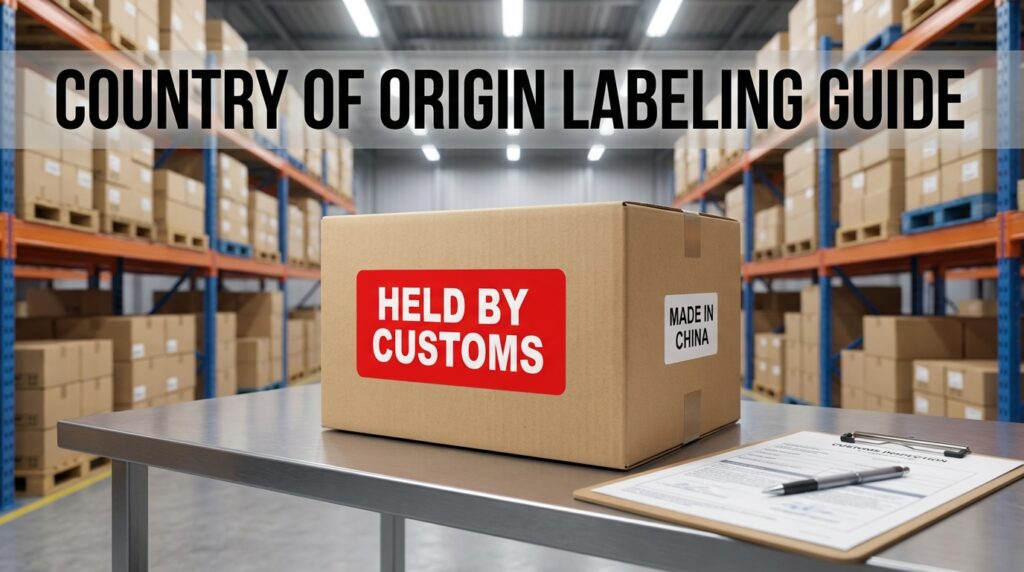

You ordered 5,000 units of your private label product. The manufacturer shipped them. Customs just seized the entire shipment because there’s no country of origin marking on the packaging. Now you’re scrambling to figure out what went wrong while your inventory sits in a warehouse you can’t access.
This happens more often than you’d think. Most new importers assume that “Made in China” labels are optional or that their freight forwarder will handle it. They don’t, and it’s not. The U.S. Customs and Border Protection (CBP) has specific rules about country of origin marking, and ignoring them costs you time, money, and sometimes your entire shipment.
This article breaks down exactly when you need country of origin labeling, what format it needs to be in, and how to avoid the mistakes that get products stuck at the border.
Key Takeaways
- Display country of origin markings on the outermost container that reaches the final buyer
- Mark products permanently if the container gets discarded before reaching the purchaser
- Verify labeling requirements before production starts, not after goods ship
- Check if your product qualifies for marking exceptions under CBP regulations
- Understand that “substantial transformation” rules determine which country to label
What Country of Origin Labeling Actually Means
Country of origin marking tells the buyer where a product was made or substantially transformed. The CBP requires this information on most imported goods and their containers.
The rule isn’t about adding a sticker because it looks official. It’s a legal requirement under 19 U.S.C. § 1304, which states that every article of foreign origin imported into the United States must be marked with the English name of the country of origin.
The marking must be legible, permanent enough to reach the final purchaser, and placed where someone can find it without destroying the container. You can’t hide “Made in China” on the bottom of a sealed box in 4-point font and call it compliant.
When the Label Needs to Be on the Product Itself
If your product’s retail packaging gets thrown away before it reaches the end customer, the marking must go directly on the item.
Let’s say you’re importing phone cases. They arrive in a cardboard master carton, then individual polybags, then the customer buys one and tosses the polybag. In this scenario, the phone case itself needs the “Made in China” mark because the outer packaging didn’t make it to the final buyer.
The same applies to bulk items sold loose. If you’re importing screws that get sold individually from a bin at a hardware store, each screw doesn’t need marking, but the bin or the product itself might, depending on how it’s presented to customers.
Here’s what matters: if the container reaches the buyer intact, mark the container. If the container gets discarded, mark the product.
When the Retail Packaging Is Enough
If your product stays in its retail packaging all the way to the customer, you can mark the outer box instead of the item inside. This works for most consumer goods sold in sealed packages.
A coffee mug sold in a printed box only needs “Made in China” on that box, not stamped on the bottom of the mug itself. The box reaches the final purchaser, so it satisfies the marking requirement.
The CBP calls this the “ultimate purchaser” rule. The marking must stay visible until the person who will actually use the product receives it. Once you know who that person is and what packaging they’ll see, you know where the label goes.
Exceptions That Let You Skip the Label
Not everything needs a country of origin mark. The CBP lists specific exceptions in 19 CFR § 134.32 and § 134.33, and knowing them saves you unnecessary labeling costs.
Products incapable of being marked without injury fall under this exception. Tiny screws, bolts, and fasteners often qualify because stamping “Made in China” on a 5mm screw would make it unusable.
Items where marking would damage the product also get a pass. If you’re importing glass ornaments and etching the country of origin would crack them, you might qualify for an exception—but you’ll need to mark the container instead.
Some low-value shipments under informal entry ($800 or less per person per day) may not require marking, but this depends on the specific circumstances and shouldn’t be relied upon for commercial imports.
Crude substances in their natural state, like rough stones or unprocessed minerals, typically don’t need marking. Neither do goods that will undergo substantial transformation in the U.S. before reaching consumers.
What “Substantial Transformation” Changes
If your imported product gets significantly changed in the United States, the country of origin might shift from China to the U.S., which affects your labeling requirements.
Substantial transformation happens when manufacturing or processing creates a new and different article with a distinct name, character, or use. Simply repackaging Chinese-made items in the U.S. doesn’t count. Neither does minor assembly.
Let’s say you import unfinished wooden furniture parts from China, then assemble, sand, stain, and finish them in your U.S. workshop. Depending on how much work you do, CBP might consider the final product U.S.-made, and you’d mark it “Made in USA” instead of “Made in China.”
The CBP makes these determinations on a case-by-case basis, and you can request a binding ruling if you’re unsure. Don’t guess. The CBP Ruling Database has thousands of examples showing how they’ve classified similar products.
How to Actually Mark Your Products
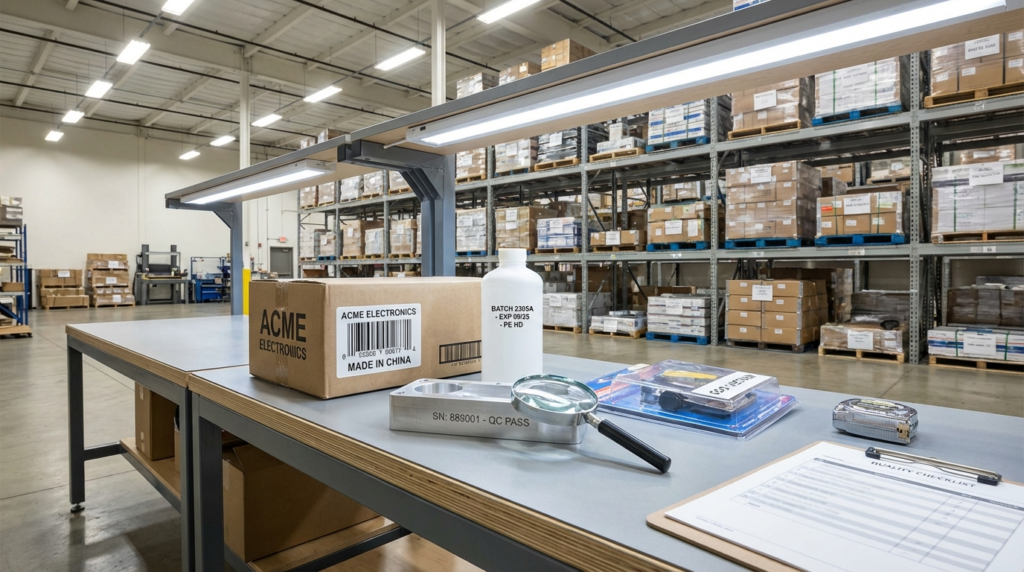
The marking needs to be conspicuous, legible, and permanent. Conspicuous means visible during normal handling. Legible means readable without tools. Permanent means it won’t come off during normal use.
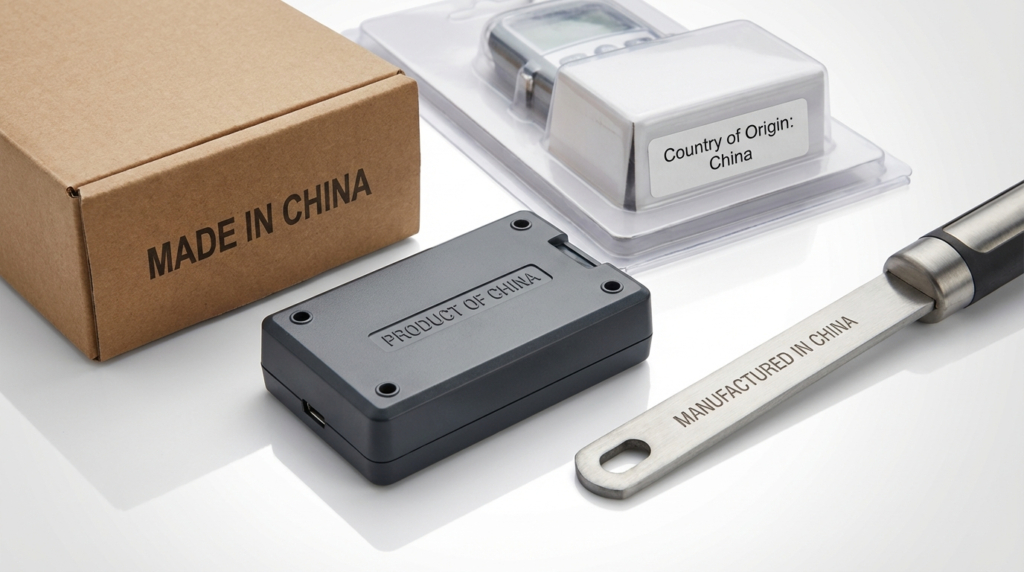
You can use labels, stickers, stamps, engravings, molding, or printing. The method depends on your product and packaging. A printed label on a cardboard box works fine. So does a molded marking on plastic parts or an engraved stamp on metal products.
The text must say the English name of the country. “Made in China,” “Product of China,” or “Manufactured in China” all work. Abbreviations don’t. “CN” or “PRC” won’t satisfy the requirement.
Font size matters too. If someone needs a magnifying glass to read your marking, it’s not conspicuous. There’s no specific minimum size in the regulations, but CBP officers use common sense—if they can’t spot it quickly, neither can consumers.
Common Labeling Mistakes That Cause Problems
Putting the label only on the master carton is the biggest mistake. If your product ships to Amazon FBA, the master carton gets broken down and individual units go to different warehouses. If those units aren’t marked, you’re not compliant.
Using removable stickers on products that will be handled frequently doesn’t meet the permanence requirement. A label that peels off after a few weeks in storage won’t reach the ultimate purchaser.
Marking the product in the wrong language causes issues. CBP specifically requires English, not Chinese characters or symbols.
Assuming your supplier handles this automatically leads to problems. Chinese manufacturers often produce for multiple markets and may not know U.S. requirements. You need to specify exactly what marking you want, where it goes, and how it should look.
What Happens When You Get It Wrong
CBP can refuse entry of unmarked goods. They’ll hold your shipment and give you a chance to fix it, but that means paying storage fees while you figure out a solution.
You might be able to mark the goods at the port under CBP supervision, but this costs money and delays your inventory. Some importers ship everything back to China for remarking, which doubles your shipping costs.
In serious cases, CBP can seize unmarked goods and you’ll forfeit the shipment entirely. They can also fine you up to the domestic value of the merchandise.
Even if your shipment gets through, selling unmarked goods violates federal law. If CBP catches it later or a competitor reports you, you’re liable for penalties.
How to Verify Before Production Starts
Check your product classification under the Harmonized Tariff Schedule. Different categories have different marking requirements, and some have specific exceptions.
Contact your manufacturer before they start production and send them detailed marking specifications. Include photos showing exactly where the mark should appear and what it should say.
Request pre-production samples with the country of origin marking in place. Don’t approve production until you’ve verified the marking meets requirements.
If you’re unsure whether your product needs marking or qualifies for an exception, file a request for a binding ruling with CBP. This gives you a written determination you can rely on.
The CBP’s Importing into the United States guide covers marking requirements in detail and provides contact information for getting specific questions answered.
Private Label Sellers: Special Considerations
If you’re putting your brand on products manufactured in China, you still need to mark the country of origin. Your brand name doesn’t replace the “Made in China” requirement.
Some sellers try to use “Designed in USA, Made in China” or similar phrases. That’s fine as additional information, but it doesn’t eliminate the need for a clear country of origin statement.
Amazon requires country of origin information on many products, but their requirements don’t override federal law. Even if Amazon doesn’t specifically require it for your category, CBP still does.
Your packaging design needs to account for the marking from the start. Don’t finalize artwork without including the required text. Trying to add it later with stickers often looks unprofessional and may not meet permanence requirements.
Creating a Compliance Checklist
Before you place your next order, verify these items:
- Confirm whether your product requires country of origin marking
- Determine if the marking goes on the product, the retail package, or both
- Specify the exact text, location, and method to your manufacturer
- Request and approve samples showing the marking
- Verify the marking will remain legible and permanent through shipping and normal use
- Document your compliance decisions in case CBP questions them later
Keep records of your communications with suppliers about marking requirements. If there’s ever a dispute, you’ll need to show you took reasonable steps to comply.
Comparison: Product vs. Container Marking
| Scenario | Where to Mark | Why |
|---|---|---|
| Retail box reaches customer | Outer packaging only | Container stays with product until final sale |
| Customer receives product without original container | Product itself | Packaging gets discarded before reaching buyer |
| Master carton broken down for individual sale | Each retail unit | Master carton doesn’t reach ultimate purchaser |
| Bulk items sold from display bin | Container or product | Depends on whether marking remains visible to buyer |
| Gift sets with multiple items | Outer gift box if sealed | Box reaches customer intact |
Working With Freight Forwarders
Your freight forwarder can spot marking issues before shipment leaves China, but only if you ask them to check. Include country of origin verification in your inspection process.
Some forwarders offer marking services where they’ll add labels or stamps in China before the goods ship. This costs less than fixing the problem at a U.S. port.
Make sure your commercial invoice and packing list accurately describe how products are marked. CBP officers compare the documents to the actual goods, and discrepancies raise red flags.
Frequently Asked Questions
Do I need “Made in China” on products sold only on Amazon?
Yes. Amazon’s policies don’t override U.S. Customs requirements. If CBP requires country of origin marking for your product category, you need it regardless of where you sell.
Can I use a sticker instead of printing directly on packaging?
Stickers work if they’re permanent enough to reach the final purchaser. Removable price-tag style stickers don’t qualify. The adhesive needs to be strong enough that normal handling won’t remove it.
What if my supplier already shipped unmarked products?
Contact your customs broker immediately. You might be able to mark the goods at the port under CBP supervision, ship them back for remarking, or request an exception if one applies. Don’t let unmarked goods enter commerce.
Does dropshipping from China change the rules?
No. Products shipped directly from Chinese suppliers to U.S. customers still need proper country of origin marking. Your business model doesn’t affect import regulations.
Conclusion
Country of origin marking isn’t complicated, but it’s not optional either. Mark the outermost container that reaches your customer, or mark the product itself if that container gets discarded. Use permanent, legible English text that clearly states where the product was made.
Handle this before production starts, not after your shipment arrives at customs. Add marking specifications to your purchase orders, verify samples, and document everything. A $20 labeling fix during production beats a $10,000 problem at the port.
What country of origin marking challenges have you dealt with in your imports? Drop your experience in the comments—your insight might save someone else from a costly mistake.