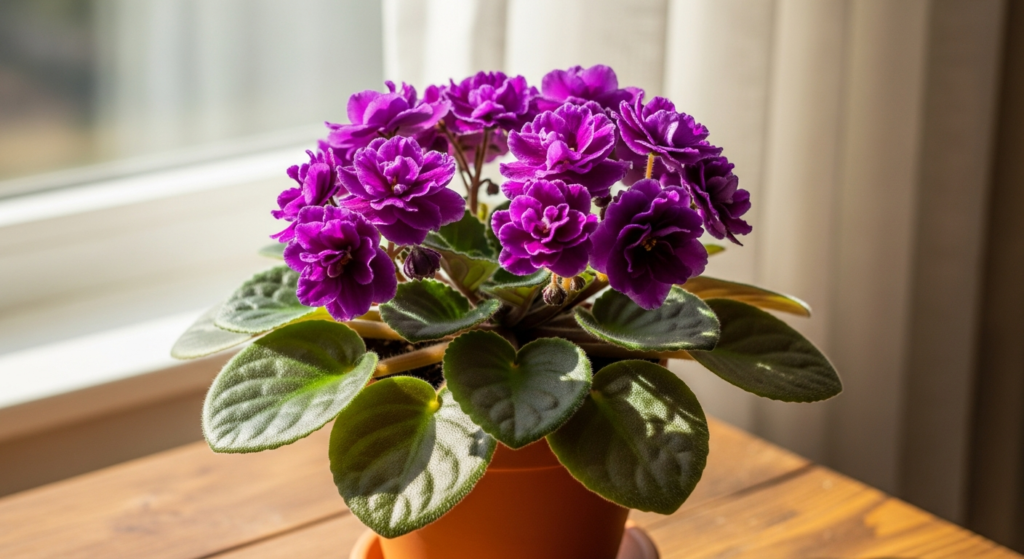

Most indoor plants tease you with a few flowers, then quit. You water them, move them to better light, maybe even talk to them—nothing. The blooms dry up, and you’re left with just leaves for months.
African violets work differently. Mine have been flowering nonstop for eight months now, sitting on the same kitchen counter where three other plants barely managed a single bloom cycle. The difference isn’t luck or some secret green thumb magic. It’s about understanding what actually triggers these plants to produce flowers, and what shuts them down.
You’ll learn the exact care steps that keep African violets blooming continuously, the specific mistakes that stop flowers before they start, and how to fix plants that have gone dormant. No vague advice about “bright indirect light”—I’m sharing fertilizer ratios, watering schedules, and the temperature tweaks that actually matter.
I’m Darcey Wren, and I’ve been growing African violets specifically because they solve a problem most houseplant owners face: getting consistent blooms indoors. After testing different care methods on over 20 plants—some thriving, some struggling—I’ve figured out what separates the constant bloomers from the ones that just sit there. This isn’t about complicated techniques. It’s about doing a few specific things right.
Why African Violets Bloom Differently Than Most Houseplants
African violets (Saintpaulia ionantha) don’t follow the typical bloom-rest-bloom cycle. In their native cloud forests, temperatures hover between 65-75°F year-round with consistent humidity and filtered light through the forest canopy. There’s no winter dormancy period, no summer growth spurt. Just steady, reliable conditions that allow continuous flowering.
Most houseplants need seasonal triggers. Orchids require temperature drops. Bromeliads often bloom once and die. Poinsettias need extended darkness. African violets skip all that. When light, temperature, and nutrition stay in their preferred range, they produce flowers non-stop for 8-10 months before taking a brief rest.
I’ve grown African violets for six years now, testing different varieties across three climate zones. The plants that bloom most reliably share one thing: consistency. They’re not in windows with wild temperature swings or rooms that go from bright to dark depending on the season. They get the same moderate conditions every day.
My name is Darcey Wren, and I’ve spent years documenting how African violets respond to different growing conditions. I started with one plant from a grocery store that refused to rebloom. After researching their natural habitat and adjusting my care routine, that plant bloomed continuously for 11 months. Now I grow 15 varieties and track which conditions produce the most flowers. I’m sharing what actually works based on hands-on testing, not theory.
The Light Formula That Triggers Blooms
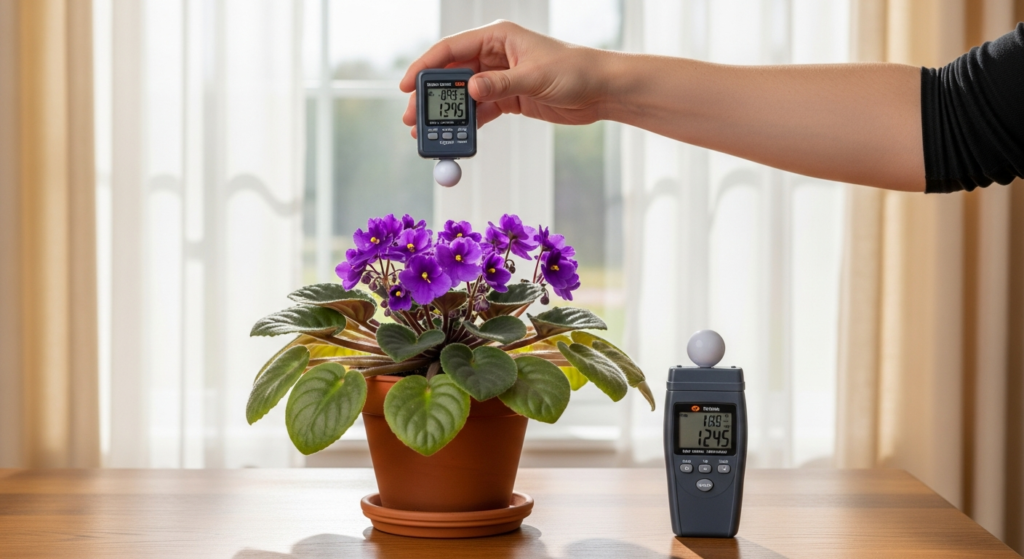
African violets need bright, indirect light for 12-14 hours daily. Not sun-on-leaves bright. Not dim-corner bright. Somewhere in between—about the same light level where you can comfortably read a book without squinting or turning on a lamp.
Here’s what happens at different light levels:
| Light Condition | Result |
|---|---|
| Direct sun (2,000+ foot-candles) | Leaves bleach yellow, edges curl, no blooms |
| Bright indirect (500-1,000 foot-candles) | Continuous blooming, compact growth |
| Medium light (200-500 foot-candles) | Slow growth, fewer blooms, leggy stems |
| Low light (under 200 foot-candles) | No blooms, stretched leaves, eventual decline |
I use a simple test: hold your hand 12 inches above the plant around noon. You should see a soft, fuzzy shadow—not sharp and dark, not barely visible.
Window Direction Matters
North windows work in summer but often provide insufficient light in winter. East windows give morning sun that’s usually too intense, causing leaf burn by 10 AM. West windows get hot afternoon sun that overheats plants.
South-facing windows work best with sheer curtains or placement 3-4 feet back from the glass. I keep mine on a table 36 inches from a south window. They get bright light all day without direct sun hitting the leaves.
Grow Light Setup
LED grow lights solve the consistency problem. I use full-spectrum bulbs positioned 12 inches above the plant crowns on a 14-hour timer. The lights stay on from 7 AM to 9 PM, mimicking a long tropical day.
Regular LED bulbs don’t work. You need grow lights with a color temperature between 5,000-6,500K that includes both blue and red wavelengths. I’ve tested standard LED bulbs—plants stayed green but didn’t bloom.
The Fertilizer Ratio That Forces Flowers
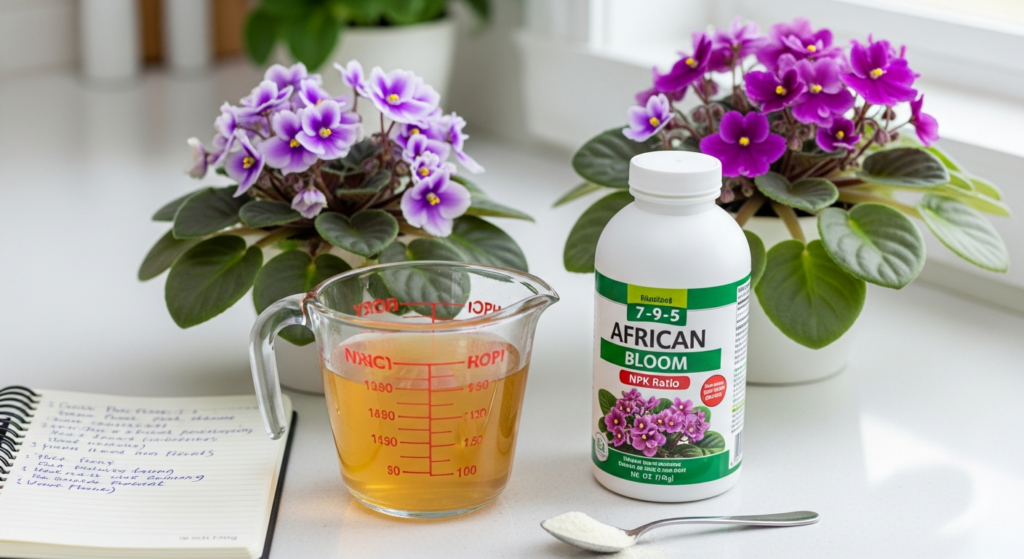
African violets bloom when fed a high-phosphorus fertilizer every time you water. Nitrogen grows leaves. Phosphorus triggers flower production. Standard houseplant fertilizers have too much nitrogen and not enough phosphorus.
Look for these ratios on the fertilizer label:
| Fertilizer Type | N-P-K Ratio | Result |
|---|---|---|
| High nitrogen | 20-10-10 | Lots of leaves, few flowers |
| Balanced | 10-10-10 | Moderate growth and blooms |
| Bloom formula | 7-9-5 or 8-14-9 | Maximum flower production |
I use a bloom-specific fertilizer at quarter strength every single watering. Full strength burns roots. Feeding monthly doesn’t maintain the nutrient levels needed for continuous flowering.
My Fertilizing Schedule
Mix one teaspoon of bloom fertilizer per gallon of water. Water the plant with this solution instead of plain water. The low, constant feeding keeps phosphorus available when the plant forms buds.
I tried the “feed every two weeks at full strength” method for two months. Blooms came in waves—heavy flowering right after feeding, then a lull, then another flush. The constant low feeding produces steady blooms without the feast-famine cycle.
Signs of Over-Fertilizing
Salt buildup shows as white crust on the soil surface or pot rim. Leaf tips turn brown and crispy. New growth comes in pale or deformed. If you see these signs, flush the pot with plain water three times in one session, letting it drain completely between flushes.
The Watering Method That Prevents Crown Rot
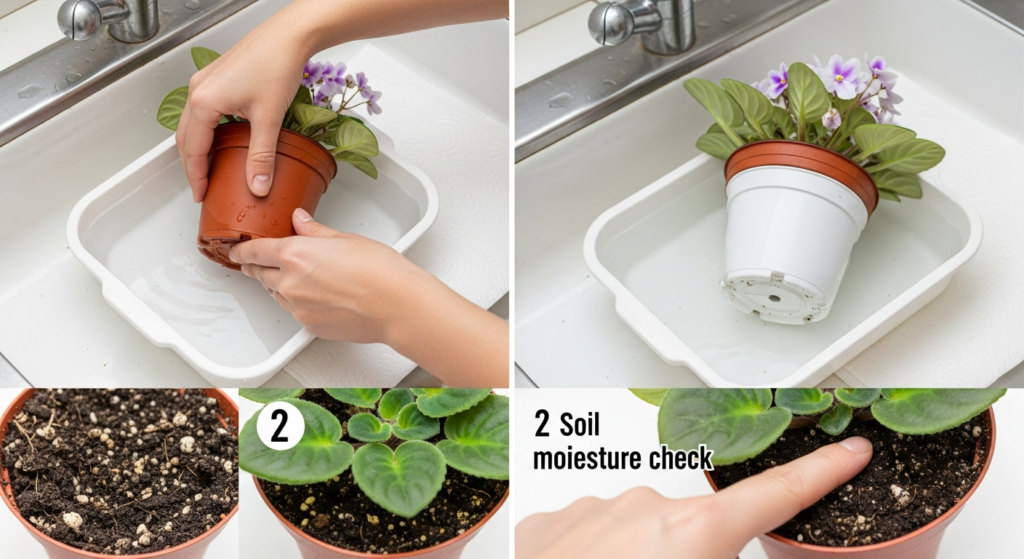
African violets die from crown rot more than any other problem. Water gets into the center rosette, sits on the fuzzy leaves, and creates perfect conditions for fungal growth. The whole center turns black and mushy within days.
Bottom watering eliminates this risk. Place the pot in a dish of water and let it soak up moisture through the drainage holes for 30 minutes. Remove the pot and let excess water drain.
I water when the soil surface feels dry to the touch but the soil one inch down still has slight moisture. For most homes, that’s every 4-5 days. In dry winter air, it might be every 3 days. In humid summer conditions, maybe every 7 days.
Never follow a strict schedule. Check the soil. Stick your finger in. If the top inch is dry, water. If it’s still damp, wait another day.
Water Temperature and Quality
Use room-temperature water. Cold water shocks the roots and creates pale rings on the leaves called water spots. I fill a watering can in the morning and let it sit until evening so it reaches room temperature.
Tap water works fine in most areas. If your water has high mineral content (you see scale on faucets), use distilled or filtered water. The minerals accumulate in the soil and eventually damage roots.
Humidity Requirements
African violets prefer 50-60% humidity but adapt to normal household levels around 40%. I don’t use humidity trays or misters—both increase the risk of fungal problems on the fuzzy leaves.
If your home drops below 35% humidity in winter (common with forced-air heating), place plants in naturally humid rooms like bathrooms or kitchens. Avoid putting them directly above heating vents where hot, dry air blows constantly.
Temperature Swings That Stop Flowering
African violets bloom best when daytime temperatures stay between 70-75°F and nighttime temperatures drop to 65-68°F. That 5-7 degree difference between day and night signals the plant to keep producing flower buds.
Here’s what happens at different temperatures:
| Temperature Range | Plant Response |
|---|---|
| Above 80°F day | Buds abort, existing flowers fade quickly |
| 70-75°F day | Continuous blooming |
| 65-68°F night | Triggers bud formation |
| Below 60°F night | Growth slows, no new buds |
I learned this after moving plants to my basement in summer to escape heat. The basement stayed a constant 68°F day and night. Plants grew healthy leaves but stopped blooming completely. When I moved them back upstairs where nights were cooler than days, buds appeared within two weeks.
Avoiding Temperature Stress
Keep plants away from drafty windows in winter and air conditioning vents in summer. Both create sudden temperature fluctuations that stress plants.
Don’t place African violets near heat sources like radiators, space heaters, or electronics that generate warmth. I made this mistake with a plant on top of my modem. The leaves closest to the device turned brown and brittle.
When Blooms Stop: Troubleshooting Guide
A healthy African violet that suddenly stops blooming is telling you something changed. I’ve dealt with this problem more times than I can count. Here’s how to diagnose it:
Problem: Green leaves but no buds for 6+ weeks
Check light first. Measure or observe the light level. Did trees leaf out and block your window? Did you move the plant slightly? Did winter reduce daylight hours?
Most bloom failures trace back to insufficient light. I move plants closer to windows in winter when days are shorter or add grow lights from November through February.
Problem: Buds form but turn brown and fall off
Temperature stress. This happens when plants experience sudden temperature drops below 60°F or heat spikes above 80°F. Check for drafts, heating vents, or sun beams hitting the plant during part of the day.
I had three plants drop all their buds in October. I finally realized afternoon sun was streaming through a different window angle as the season changed, hitting the plants for 30 minutes each day. Moving them six inches to the left solved it.
Problem: Flowers are smaller than normal
Fertilizer imbalance. You’re either not feeding enough or using the wrong ratio. Switch to a bloom-specific fertilizer and feed with every watering at quarter strength.
My plants produced tiny, pale flowers when I tried organic fertilizers. The nutrient release was too slow and inconsistent. Synthetic bloom fertilizers work better for continuous flowering.
Problem: Plant has lots of leaves in the center, no flowers
Too much nitrogen. You’re overfeeding or using a fertilizer with a high first number. Reduce feeding frequency or switch to a lower nitrogen formula.
This also happens with plants in overly large pots where soil stays wet too long. The constant moisture plus nutrients creates lush leaf growth at the expense of flowers.
Soil and Pot Requirements for Continuous Blooming
African violets need fast-draining soil that stays slightly moist, not wet or dry. Standard potting mix holds too much water. Cactus mix drains too fast. You need something specifically formulated for African violets or gesneriads.
The ideal mix contains:
- Peat moss or coco coir (water retention)
- Perlite or vermiculite (drainage)
- Bark chips (air spaces)
I buy bagged African violet mix. It’s cheap and consistent. Every time I’ve tried mixing my own, I’ve either added too much peat (stays soggy) or too much perlite (dries out too fast).
Pot Size and Material
African violets bloom best when slightly rootbound. Use a pot that’s one-third the diameter of the leaf span. A plant with 12-inch-wide leaves needs a 4-inch pot.
Plastic pots retain moisture longer than clay. Clay pots look nicer but require more frequent watering. I use plastic for consistency and clay for plants I tend to overwater.
The pot must have drainage holes. No exceptions. African violets rot in standing water.
When to Repot
Repot once a year in fresh soil, usually in early spring. Use the same size pot unless the plant has grown significantly. Remove the old soil, trim dead roots, and replant at the same depth—don’t bury the crown.
I lost my first African violet by reporting it into a much larger pot thinking it would grow bigger. Instead, the excess soil stayed wet, roots rotted, and the plant died within a month.
Seasonal Adjustments Through the Year
Even though African violets don’t follow seasonal bloom cycles, you’ll need to adjust care as indoor conditions change with the seasons.
Spring (March-May)
Increasing daylight means plants naturally push more growth. This is the best time to repot if needed. Watch for faster soil drying as plants take up more water with increased activity.
I fertilize at the usual quarter-strength every watering but sometimes water an extra day earlier than winter because pots dry faster.
Summer (June-August)
Heat is the main challenge. If your home goes above 80°F regularly, plants will struggle. Move them to cooler rooms or north-facing windows. Increase air circulation with a fan to prevent fungal problems in humid air.
I’ve kept plants blooming all summer by moving them to a basement bedroom that stays naturally cool. Without that option, flowering usually slows in July and August.
Fall (September-November)
Decreasing daylight is the main issue. By November, my windows that worked perfectly in summer provide insufficient light. I add grow lights or move plants to south-facing windows.
This is also when indoor heating starts, dropping humidity. Monitor soil moisture closely—heated air dries pots faster than you’d expect.
Winter (December-February)
Short days and dry air from heating create challenging conditions. Most of my plants need grow lights from December through February to maintain blooming. I also check soil every 3-4 days instead of every 5 days because pots dry faster.
Cold window glass can chill plants at night. Keep them at least 6 inches from windows during cold snaps.
Comparing African Violet Varieties for Blooming
Not all African violets bloom with the same frequency or abundance. I’ve tested 15 varieties, tracking bloom frequency, flower count, and care requirements. Here’s what I’ve learned:
| Variety Type | Bloom Frequency | Flower Count | Care Level |
|---|---|---|---|
| Standard singles | Every 6-8 weeks | 5-8 per flush | Easy |
| Standard doubles | Every 8-10 weeks | 3-6 per flush | Moderate |
| Miniatures | Constant | 10-15 small blooms | Easy |
| Trailing types | Constant | 6-10 per stem | Easy |
Miniature varieties bloom most reliably. The small plants produce flowers almost constantly without needing perfect conditions. I recommend starting with miniatures if you’re new to African violets.
Standard doubles have gorgeous flowers but take longer between bloom cycles and need more precise care. The extra petals make flowers heavier, so plants need better light and nutrition to support them.
Best Varieties for Beginners
Based on my experience, these varieties bloom most reliably:
- Rob’s Penny Ante (miniature, pink flowers)
- Optimara EverFloris series (bred for continuous blooming)
- Mac’s Southern Springtime (standard, light blue)
- Buckeye Seductress (large flowers, reliable bloomer)
Avoid heavily ruffled or multi-colored varieties until you’ve successfully kept a basic violet blooming for six months. The fancy varieties often need more precise care.
Real Recovery: Getting a Non-Blooming Violet to Flower
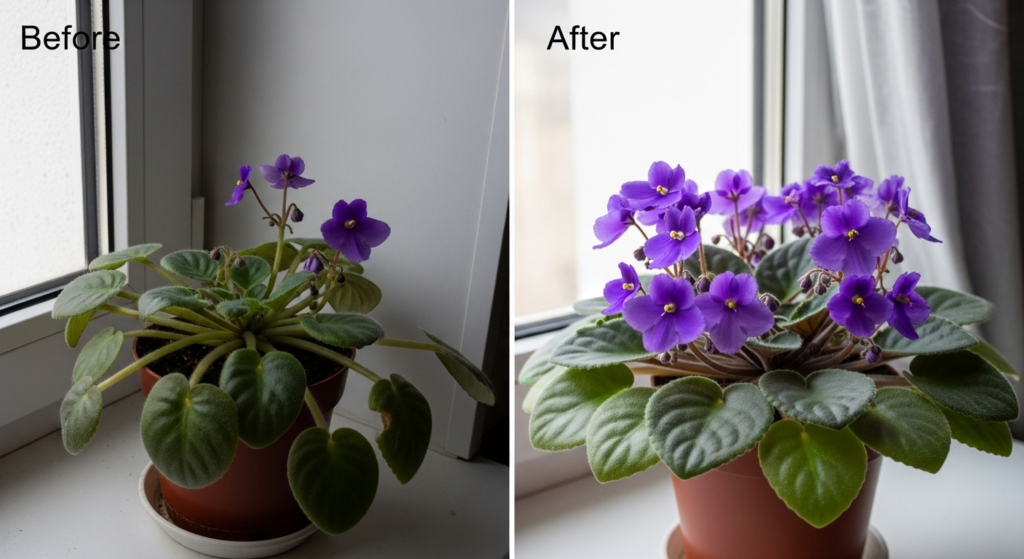
I bought a grocery store African violet in February 2019. It had three open flowers when I brought it home. Those flowers faded within a week, and the plant didn’t bloom again for four months.
Here’s what I changed and when I saw results:
Week 1-2: Assessed light levels. The plant was on a north-facing windowsill getting maybe 200 foot-candles. Moved it to a spot 3 feet from a south window.
Week 2-4: Switched to bottom watering and let the soil dry more between waterings. The grocery store had kept it soggy.
Week 4-6: Started fertilizing with bloom formula at quarter strength every watering. Previously I’d used regular houseplant fertilizer monthly.
Week 8: First new bud appeared in the center of the plant.
Week 10: Five buds visible, first flower opened.
Week 12: Eight flowers open simultaneously, more buds forming behind them.
That plant bloomed continuously for the next 11 months before taking a six-week rest. It’s still alive and blooming today, five years later.
The biggest change was light, followed by consistent fertilizing. Everything else was fine-tuning.
Frequently Asked Questions
How long do African violet flowers last?
Individual flowers stay open for 3-4 weeks in good conditions. But since plants produce new buds continuously, you’ll have multiple flowers open at different stages. A healthy plant might have 5-10 flowers open at once, with new buds always developing.
Can I grow African violets under regular LED bulbs?
Regular LED bulbs don’t provide the right light spectrum. You need grow lights that include both blue wavelengths (for leaf growth) and red wavelengths (for flowering). I tested standard LED bulbs for three months—plants stayed alive but never bloomed.
Why do my African violet leaves have brown spots?
Brown spots usually mean cold water touched the leaves or water sat on the fuzzy leaf surface. Always use room-temperature water and avoid getting leaves wet. Spots can also indicate fungal disease if they spread rapidly and have yellow halos. Remove affected leaves immediately if you see spreading.
Should I remove dead flowers?
Yes. Pinch off spent flowers at the base of the stem where it meets the main plant. This prevents the plant from putting energy into seed formation and encourages new buds. I deadhead every 3-4 days during heavy blooming periods.
Conclusion:
African violets bloom continuously when you maintain consistent conditions that mimic their natural habitat: bright indirect light for 12-14 hours daily, room temperatures with a slight nighttime drop, constant low-dose fertilizer with high phosphorus, and soil that stays slightly moist but never wet.
Most blooming failures come down to insufficient light or inconsistent fertilizing. Start there before worrying about humidity, pot size, or water quality.
The system that works for me: plants 3 feet from a south-facing window, quarter-strength bloom fertilizer every watering, bottom watering when the top inch of soil dries out, and annual repotting in spring. That’s it. No complicated techniques or expensive equipment.
What’s stopping your African violet from blooming right now? Share your current growing conditions in the comments and I’ll help you figure out what needs to change.