

You’ve just created what looks like the perfect logo using MidJourney or DALL-E. It’s sleek, professional, and exactly what your new business needs. But before you slap it on your products and launch your brand, there’s a critical question: can you actually trademark this AI-generated design?
The short answer? It’s complicated—and getting it wrong could cost you thousands in legal fees or leave your brand unprotected when you need it most.
Here’s what makes this issue so frustrating: AI tools make logo creation easier than ever, but trademark law was written decades before anyone imagined algorithms designing graphics. You’re left navigating a legal gray zone where one wrong move could mean losing your brand identity or facing infringement claims.
This article breaks down exactly what you can and can’t do with AI-generated logos, how trademark protection actually works for AI art, and the steps you need to take to protect your brand legally.
Key Takeaways
- Modify AI outputs significantly to establish human authorship and trademark eligibility
- Conduct comprehensive trademark searches before using any AI-generated logo commercially
- Document your creative process to prove substantial human contribution to the design
- Consult a trademark attorney before filing applications for AI-assisted branding materials
- Understand that copyright and trademark are separate legal protections with different requirements
Understanding Trademark vs. Copyright for AI Art
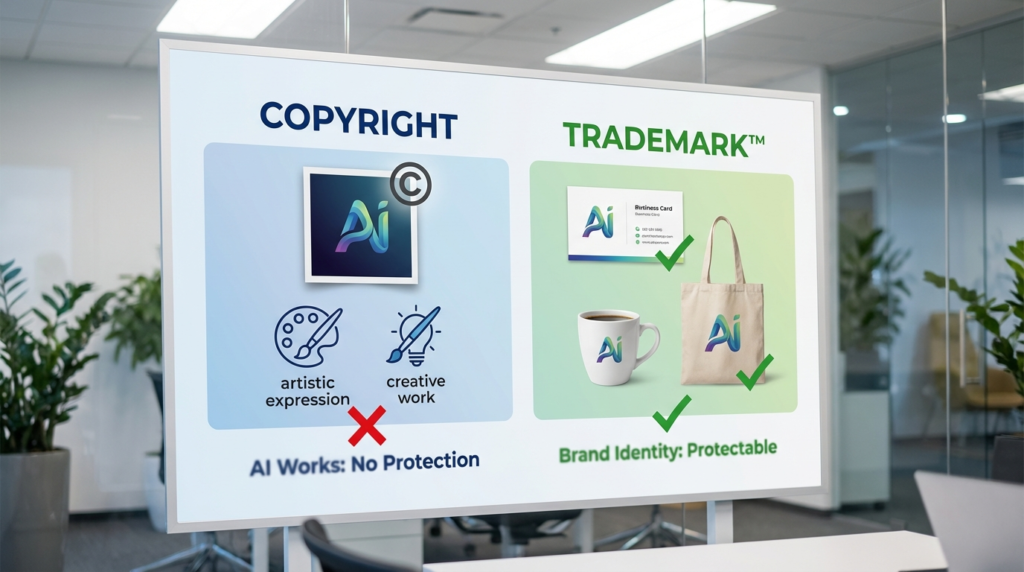
Most people confuse these two types of protection, but they serve completely different purposes for your AI-generated logo.
Copyright protects the artistic expression itself—the actual image file. Trademark protects how you use that image to identify your business. Here’s the distinction that matters: you don’t necessarily need to own the copyright to trademark a logo, but you do need to prove you’re using it consistently to represent your brand.
The U.S. Copyright Office has stated clearly that AI-generated works without substantial human authorship can’t receive copyright protection. But trademark law operates differently. The USPTO (United States Patent and Trademark Office) evaluates whether your mark distinguishes your goods or services from competitors, not whether an AI created it.
This creates an interesting loophole. Even if your AI logo lacks copyright protection, you might still trademark it—assuming it meets other requirements.
Can You Actually Trademark an AI-Generated Logo?
Yes, but with significant caveats that most creators don’t realize until it’s too late.
The trademark office doesn’t explicitly reject applications just because AI created the design. They focus on functionality, distinctiveness, and whether the mark creates confusion with existing trademarks. However, you’ll face challenges that traditionally designed logos don’t encounter.
The real obstacles:
First, proving ownership becomes murky. If you can’t copyright the raw AI output, other people could generate similar designs using the same prompts. This weakens your trademark’s strength and makes enforcement nearly impossible.
Second, if your logo is too generic or commonly generated by AI tools, the trademark office will reject it for lacking distinctiveness. AI models trained on millions of images often produce similar results for common prompts like “minimalist tech logo” or “abstract coffee shop design.”
Third, you need to demonstrate actual commercial use. Filing an intent-to-use application requires you to eventually prove you’re using the mark in commerce, which means you’ll be building your entire brand on something you might not fully control.
The Human Authorship Problem
This is where things get legally messy.
Current trademark applications require you to declare ownership and the right to use the mark. If challenged, you might need to prove how the logo was created. Saying “I typed a prompt into MidJourney” probably won’t hold up under scrutiny.
Courts and trademark examiners increasingly want to see substantial human creative input. This means:
Selecting and arranging multiple AI-generated elements into a unique composition shows creative choice. If you generate 50 versions and carefully choose specific elements from different outputs, you’re making creative decisions.
Modifying the output in graphic design software adds human authorship. Color adjustments, typography changes, or combining AI elements with hand-drawn components strengthen your claim.
Directing the creative process through detailed, iterative prompting demonstrates intent. Save your prompt history and document your refinement process.
The more you can prove you guided the creative outcome rather than just accepting whatever the AI produced, the stronger your legal position becomes.
What Makes an AI Logo Trademarkable
Not all AI-generated designs qualify for trademark protection, even with modifications.
Your logo needs to be distinctive enough to identify your specific business. Generic symbols that AI commonly produces—like abstract swooshes, gradient circles, or standard geometric patterns—will struggle to pass trademark examination.
The USPTO uses a spectrum of distinctiveness:
| Category | Description | Trademark Strength | Example |
|---|---|---|---|
| Generic | Common terms for products/services | Not trademarkable | “Computer Store” for a computer shop |
| Descriptive | Describes what you sell | Weak, requires secondary meaning | “Fast Pizza” for pizza delivery |
| Suggestive | Hints at qualities without describing | Moderate protection | “Greyhound” for bus service |
| Arbitrary | Common words used in unrelated context | Strong protection | “Apple” for technology |
| Fanciful | Invented words or unique designs | Strongest protection | “Kodak” or highly unique logos |
AI-generated logos that lean toward generic or descriptive categories face rejection. You need something that falls into suggestive, arbitrary, or fanciful territory.
Additionally, your logo can’t create confusion with existing trademarks. Run comprehensive searches through the USPTO database and broader internet searches before committing to any AI design.
Steps to Protect Your AI-Generated Logo
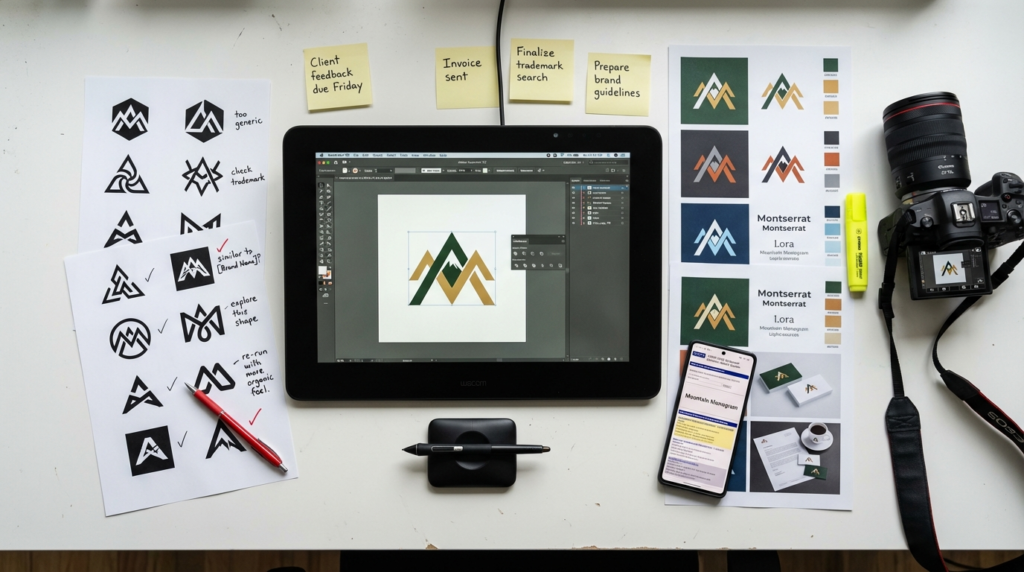
If you’re determined to use AI-created branding, follow this process to maximize legal protection.
Start with extensive generation. Don’t use the first logo the AI spits out. Generate hundreds of variations, save everything, and document the entire creative journey. This evidence proves you engaged in a selection process requiring creative judgment.
Make substantial modifications. Open the AI output in design software like Adobe Illustrator or Affinity Designer. Change colors, adjust proportions, add custom typography, or combine elements from multiple generations. The goal is transforming the raw AI output into something distinctly yours.
Create a design story. Write down your creative intent, the problems you were solving, and why you made specific choices. This documentation becomes crucial if you ever need to defend your trademark.
Search existing trademarks thoroughly. Use the USPTO’s TESS database and consider hiring a trademark attorney to conduct a comprehensive search. Finding conflicts before you build your brand saves massive headaches later.
File your trademark application honestly. When asked about the design’s creation, be truthful about AI involvement while emphasizing your creative contributions. Lying on trademark applications can invalidate your registration later.
Use the mark in commerce. Trademark rights come from actual use, not just filing paperwork. Put your logo on products, websites, and marketing materials. Consistent use strengthens your claim.
Commercial Risks You Can’t Ignore
Even if you successfully register your trademark, AI-generated logos carry ongoing risks traditional designs don’t face.
Someone else might generate a nearly identical logo using similar prompts. Unlike copyright infringement, where you’d have clear legal grounds, proving trademark infringement becomes difficult when both parties independently created similar designs through AI.
Your trademark could face cancellation challenges. Competitors might argue your mark lacks sufficient originality or that you don’t have legitimate ownership rights. These legal battles cost tens of thousands of dollars.
Licensing and selling your brand becomes complicated. If you ever want to sell your business or license your logo, buyers will scrutinize your IP rights. Weak ownership claims devalue your brand significantly.
Better Alternatives to Pure AI Generation
Smart businesses use AI as a starting point, not the final product.
Hire a designer to refine AI outputs. A professional can take AI-generated concepts and transform them into properly protected artwork. This approach gives you clear copyright ownership while leveraging AI’s speed for initial ideation.
Use AI for inspiration only. Generate ideas with AI tools, then recreate the concepts manually or hire artists to interpret them. This completely sidesteps ownership questions.
Commission hybrid work. Many designers now offer services where they use AI in their workflow but provide traditional work-for-hire agreements giving you full rights to the final product.
Focus on wordmarks instead of logos. Text-based trademarks face fewer AI-related complications. You can trademark your business name in a specific font, and even if AI helped design that font treatment, the name itself carries the trademark value.
International Considerations
Trademark protection varies dramatically between countries, and AI art adds another layer of complexity.
The European Union takes a stricter stance on AI-generated works. Their copyright framework emphasizes human creativity more explicitly than U.S. law. If you plan to operate internationally, research how different jurisdictions treat AI-created intellectual property.
Some countries don’t recognize trademarks without proper copyright backing. This could limit your ability to enforce your brand abroad.
The World Intellectual Property Organization provides resources on international trademark treaties, though their guidance on AI-generated works continues evolving. Check their database before assuming your U.S. trademark will translate globally.
The Role of AI Disclosure
Should you tell the trademark office that AI created your logo? There’s no straightforward answer, but transparency generally serves you better than secrecy.
The USPTO doesn’t currently require AI disclosure on trademark applications. However, making false statements about creation can invalidate your registration if discovered later. If the application asks about design ownership or creation, being vague or dishonest creates legal exposure.
A better approach: emphasize your role in the creative process. “I directed the creation of this logo through iterative design refinement” is truthful whether you used AI tools, traditional software, or both.
As regulations evolve, expect more explicit questions about AI involvement. The USPTO’s official stance on emerging technologies continues developing, so check their current guidance before filing.
Enforcement Challenges
Getting a trademark approved is only half the battle—you also need to defend it.
If someone copies your AI-generated logo, proving infringement requires showing they copied YOUR specific mark, not that they independently generated something similar. This becomes nearly impossible if both of you used comparable AI prompts.
Traditional logos have clear creation timelines and design files proving originality. AI logos lack this paper trail unless you’ve meticulously documented everything.
Budget for potential legal challenges. If your brand grows valuable, expect competitors to test your trademark’s validity. Having weak AI-based ownership claims makes you vulnerable to these attacks.
Practical Recommendations
Here’s what you should actually do if you want to build a brand using AI-assisted design.
Treat AI as a tool in a larger creative process, not the entire solution. Just like you wouldn’t trademark raw Photoshop filters, don’t trademark unmodified AI outputs.
Invest in professional legal review before committing to any logo. A trademark attorney can evaluate your specific design’s protectability and suggest modifications that strengthen your position.
Build brand value beyond the logo itself. Trademarks protect source identification, so focus on making your business name, reputation, and customer experience the real assets. The logo is just one element.
Consider provisional protection strategies. Use your AI-assisted logo while simultaneously working with designers on a more defensible final version. This lets you launch without waiting while building toward stronger IP protection.
Stay informed about legal developments. AI and intellectual property law is changing rapidly. What’s true today might shift significantly within months.
Frequently Asked Questions
Can I trademark a logo made entirely by AI without any modifications?
Technically yes, if it meets distinctiveness requirements and doesn’t conflict with existing marks. However, you’ll have weak ownership claims and limited ability to prevent others from generating similar designs. The trademark office won’t reject it solely for being AI-generated, but you face significant practical and legal risks.
What happens if someone else generates the same AI logo and tries to trademark it?
Priority typically goes to whoever used it in commerce first, not who generated it first. However, both parties might face challenges proving exclusive rights. This scenario often results in costly legal disputes with uncertain outcomes, which is exactly why substantial human modification is so important.
Do I need to tell clients or investors that my logo is AI-generated?
There’s no legal requirement to disclose this to customers, but investors conducting due diligence will examine your IP portfolio. Weak trademark claims can significantly impact business valuations. Being upfront about your IP situation with investors is generally smarter than having them discover weaknesses during legal review.
Can I copyright the modified version of an AI-generated logo?
Possibly, if your modifications constitute sufficient human authorship. Small color changes probably won’t qualify, but substantial redesign work might. The Copyright Office evaluates each case individually. Document your modification process extensively and consider consulting an IP attorney about your specific situation.
Wrapping This Up
AI-generated logos sit in a legal gray zone that’s still being defined by courts and regulators. You can trademark them, but you’re building your brand on shakier legal ground than traditionally created designs offer.
The smartest approach combines AI’s efficiency with human creativity and legal protection. Use AI to generate concepts quickly, but invest in modifications that establish clear ownership. Document everything about your creative process. Run comprehensive trademark searches. And seriously consider hiring professionals for both the design refinement and legal filing.
Your logo represents your business identity. Cutting corners on its legal protection to save a few hundred dollars now could cost you everything you build later. Don’t let the ease of AI generation seduce you into skipping the foundational work that actually protects your brand.
What’s your biggest concern about using AI-generated designs for your business? Drop a comment below—the legal landscape keeps changing, and hearing different perspectives helps everyone navigate these issues better.