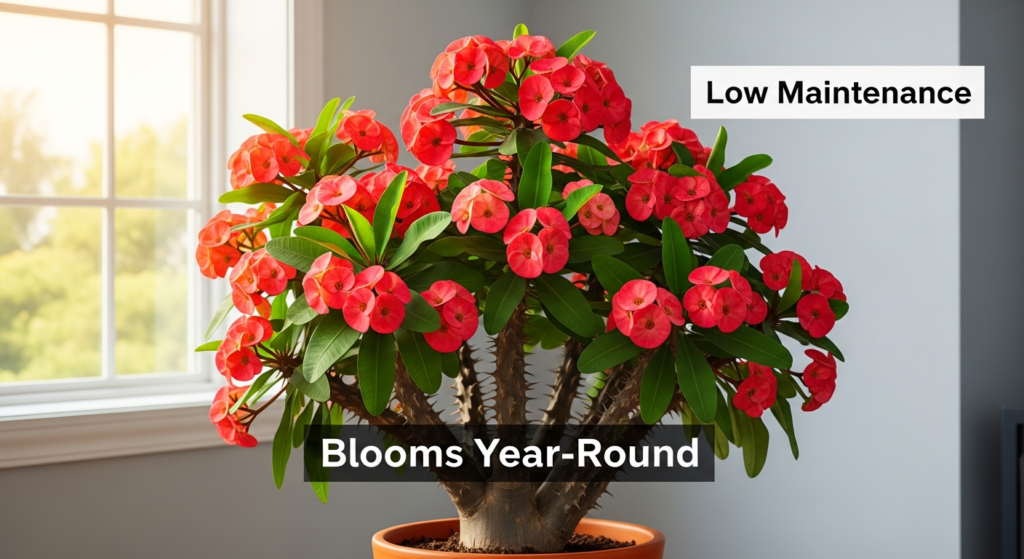

You want a plant that flowers without constant attention. You’re tired of orchids that bloom once then sit green for months. You’ve killed fiddle leaf figs and peace lilies. Maybe you travel for work, or you just forget to water things. Whatever the reason, you need something tougher.
Crown of Thorns (Euphorbia milii) might be exactly what you’re looking for. This succulent produces tiny flowers almost continuously when given basic care. It survives weeks of neglect. It tolerates dry indoor air better than most houseplants. But those thorns are real, and the milky sap can irritate skin—details that matter if you have curious kids or pets.
By the end of this guide, you’ll know whether this plant fits your home, how to keep it flowering, and how to avoid the common mistakes that cause problems.
I’m Darcey Wren, and I’ve been growing and writing about indoor flowering plants for several years now. My interest in Crown of Thorns started after I killed my third African violet. I needed something forgiving, something that could handle my irregular watering schedule. That first Crown of Thorns taught me that low-maintenance doesn’t mean no maintenance—it just means the plant works with you instead of against you.
What Makes Crown of Thorns Different From Other Succulents
Most succulents save their energy. They grow slowly, store water, and flower rarely if at all indoors. Crown of Thorns breaks that pattern. It produces clusters of small flowers surrounded by colorful bracts (modified leaves that look like petals). These bracts stay bright for weeks, sometimes months.
The plant originates from Madagascar, where it grows in rocky, dry conditions. This background explains its drought tolerance and its need for bright light. Indoors, it adapts to container life better than many succulents because it naturally grows as a small shrub rather than a ground-hugging cluster.
The stems are thick and woody, covered in sharp thorns about half an inch long. New growth emerges green and soft, hardening as it matures. Leaves grow along the stems in loose clusters, and they’ll drop during stress—drought, cold, or relocation. This is normal. The plant isn’t dying; it’s conserving resources.
Common names and varieties:
- Standard red is the most common color
- Hybrid varieties bloom in pink, yellow, white, salmon, and bi-colors
- Dwarf varieties stay under 12 inches tall
- Giant Thai hybrids can reach 3-4 feet with larger flower clusters
Understanding the Bloom Cycle
Crown of Thorns flowers appear at the tips of branches. Each flower cluster includes tiny actual flowers (usually yellow or white) surrounded by two to four bracts. The bracts provide the color and last much longer than the flowers themselves.
In ideal conditions, the plant blooms continuously. In reality, you’ll see heavier blooming periods alternating with lighter flowering. This isn’t a problem—it’s the plant’s natural rhythm. Pushing for constant maximum bloom stresses the plant and reduces overall health.
| Season | Typical Bloom Behavior | Light Needs | Watering Frequency |
|---|---|---|---|
| Spring | Heavy flowering begins | 4-6 hours direct sun | Every 7-10 days |
| Summer | Peak bloom period | 6+ hours, protect from intense afternoon heat | Every 5-7 days |
| Fall | Moderate flowering continues | 4-6 hours direct sun | Every 10-14 days |
| Winter | Slower growth, reduced flowers | Maximum available light | Every 14-21 days |
The plant needs a rest period. Even though it can bloom year-round, forcing constant growth weakens it. During winter, reduced watering and cooler temperatures (but still above 50°F) encourage stronger spring flowering.
Light Requirements: Why Location Matters More Than You Think
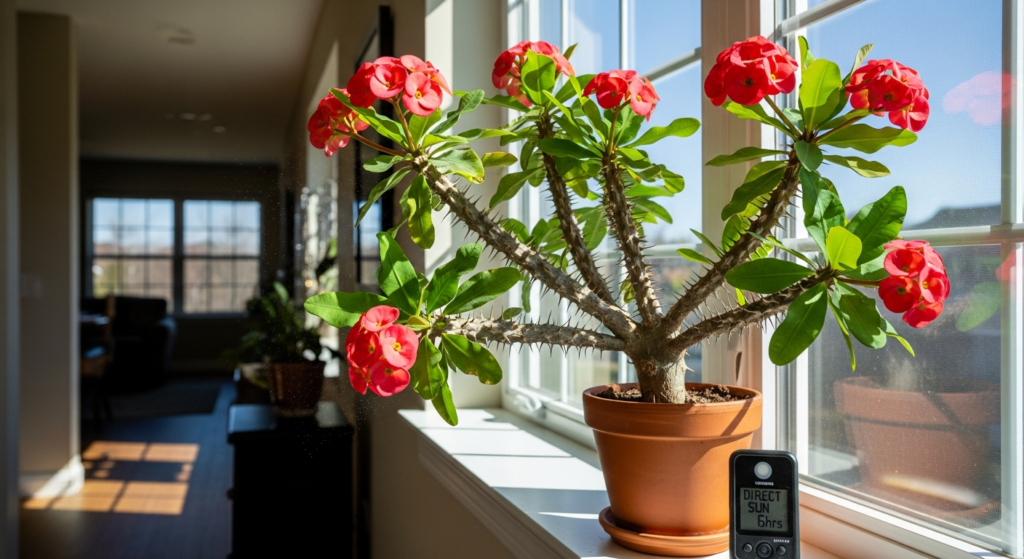
Crown of Thorns needs direct sunlight to flower well. Not bright indirect light. Not a few morning sun rays. Actual direct sun hitting the leaves for at least four hours daily.
I learned this the hard way. My first plant sat in an east-facing window, getting gentle morning light. It grew. It looked healthy. It produced maybe three flower clusters in six months. When I moved it to a south-facing window with afternoon sun, the difference showed within weeks—new growth, more branches, and flowers appearing at every growing tip.
Window direction and flowering:
- South-facing: Best option in most homes, provides consistent strong light
- West-facing: Works well, afternoon sun supports good flowering
- East-facing: Adequate for survival, reduced flowering
- North-facing: Insufficient for flowering, plant will gradually decline
If you don’t have a suitable window, the plant won’t thrive. Skip Crown of Thorns and choose something more shade-tolerant. Trying to make it work in low light leads to stretching stems, leaf drop, and almost no flowers.
Grow lights can substitute for natural sun. You need full-spectrum lights positioned 6-12 inches above the plant, running 12-14 hours daily. This setup works, but it requires commitment and slightly higher electricity costs.
Watering Strategy for Succulents That Actually Flower
Most succulent care advice says “water infrequently.” That’s partially true for Crown of Thorns, but flowering uses energy and water. The plant needs more moisture during active growth than a jade plant or echeveria.
Here’s the approach that works: let the soil dry completely between waterings, then water thoroughly until excess drains from the bottom. Don’t mist. Don’t give small sips. Saturate the root ball, then wait.
Checking soil moisture:
Stick your finger two inches into the soil. If it’s dry at that depth, water. If there’s any moisture, wait another few days. This simple test prevents both overwatering and underwatering.
During active growth (spring and summer), expect to water every 5-10 days. During dormancy (winter), extend that to 14-21 days or longer. Room temperature and humidity affect this schedule. A warm, dry home means more frequent watering than a cool, humid space.
The plant will tell you when it needs water. Leaves wrinkle slightly and lose their glossy appearance. Stems may look slightly shriveled. These are early warning signs. If leaves start dropping rapidly, you’ve waited too long or overwatered—check the soil to determine which.
Soil Mix and Container Selection
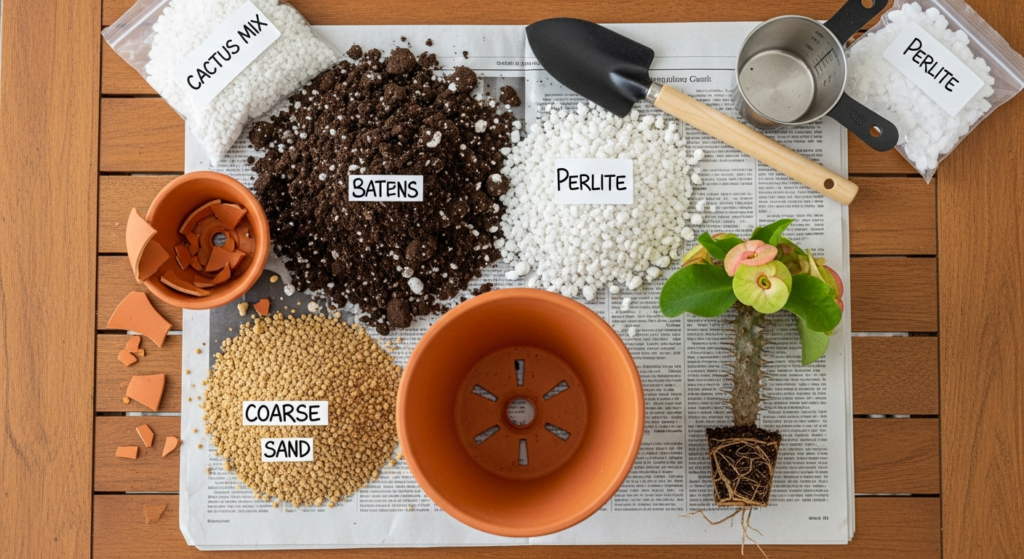
Regular potting soil holds too much water. Crown of Thorns needs fast-draining mix that prevents root rot. You can buy cactus soil or make your own.
Basic soil recipe:
- 2 parts cactus/succulent mix
- 1 part perlite or pumice
- Optional: 1 part coarse sand for extra drainage
The mix should feel gritty, not dense or muddy. Water should soak through quickly, not pool on the surface.
Container choice matters as much as soil. Terracotta pots work well because they’re porous—excess moisture evaporates through the sides. Plastic works too, but you’ll need to water less frequently. Whatever material you choose, drainage holes are required. No exceptions.
Size the pot appropriately. Too large, and soil stays wet too long. Too small, and the plant dries out too fast and becomes unstable. Choose a container about 1-2 inches wider than the root ball.
Fertilizer Needs for Continuous Blooming
Flowering takes nutrients. Crown of Thorns grows in poor soil naturally, but container plants exhaust available nutrients within months. Regular feeding supports consistent bloom production.
I use diluted liquid fertilizer every 3-4 weeks during spring and summer. Half-strength balanced fertilizer (10-10-10) works. So does cactus-specific fertilizer. Avoid high-nitrogen formulas that promote leaf growth over flowers.
Stop fertilizing in late fall and winter. The plant grows slowly during this period and doesn’t need extra nutrients. Resume feeding when you see new growth emerging in spring.
| Fertilizer Type | NPK Ratio | Application Frequency | Best For |
|---|---|---|---|
| Balanced liquid | 10-10-10 | Every 3-4 weeks (growing season) | General growth and flowering |
| Bloom booster | 5-10-10 | Every 4 weeks (growing season) | Maximum flower production |
| Cactus formula | 2-7-7 | Every 4-6 weeks (growing season) | Succulents adapted to low nutrients |
| Slow-release granules | 14-14-14 | Once every 3 months | Consistent feeding with less effort |
Over-fertilizing causes salt buildup in the soil. Signs include white crust on the soil surface and brown leaf tips. Flush the soil with plain water occasionally to prevent this.
Temperature and Humidity Considerations
Crown of Thorns tolerates normal household temperatures well. The ideal range sits between 65-85°F. It survives brief exposure to 50°F but suffers damage below that. Frost kills it.
Keep the plant away from cold drafts in winter—near doors, leaky windows, or air conditioning vents. Sudden temperature drops cause leaf loss even if the plant isn’t technically damaged.
Humidity doesn’t matter much. The plant evolved in areas with seasonal drought and handles dry indoor air better than most flowering houseplants. Average household humidity (30-50%) works fine. You don’t need to mist, use pebble trays, or run a humidifier.
Pruning and Shaping Your Plant
Crown of Thorns grows slowly but steadily. Left alone, it becomes leggy—long stems with flowers only at the tips. Pruning creates bushier growth and more flowering points.
Prune in early spring before the main growth period begins. Use clean, sharp pruning shears. Cut stems back by one-third to one-half their length, making cuts just above a leaf node or branch junction.
Important safety note: The plant bleeds white milky sap when cut. This latex can irritate skin and is toxic if ingested. Wear gloves while pruning. Keep sap away from eyes and mouth. Wash tools after use. Let cut stems callus (dry) for a day before handling them further.
The plant responds to pruning by producing multiple new branches from below the cut. More branches mean more potential flowering sites. Within a few weeks, you’ll see new growth emerging.
Remove dead or damaged stems anytime. Cut them back to healthy tissue or to the main stem. This cleanup pruning doesn’t require waiting for spring.
Propagation: Growing New Plants From Cuttings
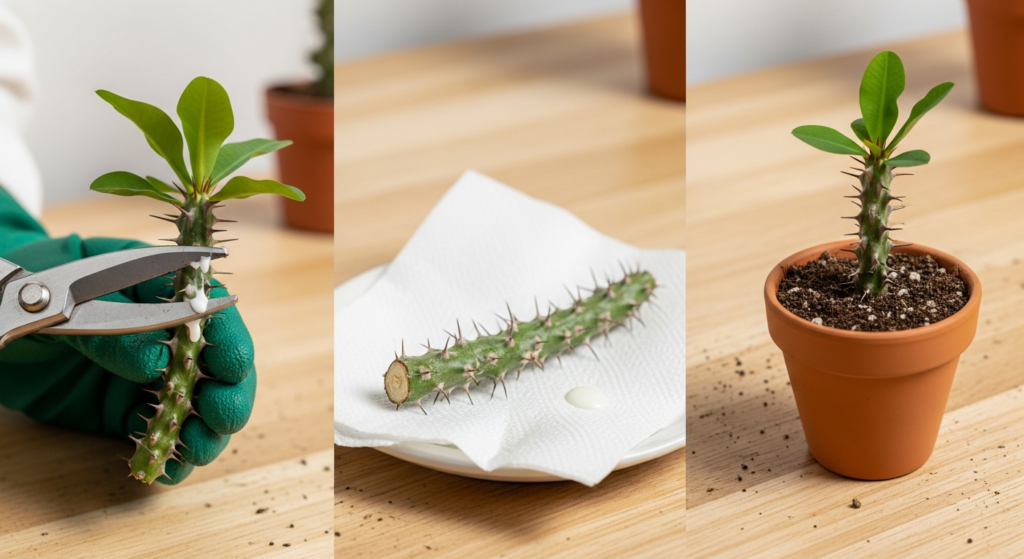
Crown of Thorns propagates easily from stem cuttings. This lets you create backup plants, share with friends, or expand your collection of different colors.
Step-by-step propagation process:
- Take cuttings 3-4 inches long from healthy stems
- Let cut ends dry for 2-3 days until they callus over
- Plant in barely moist cactus soil mix
- Place in bright, indirect light (not direct sun initially)
- Water sparingly—just enough to prevent complete drying
- Roots develop in 3-6 weeks
- Resume normal care once new growth appears
The callusing step prevents rot. Fresh cuts sitting in moist soil often develop fungal problems. Dried, healed cuts root more reliably.
Some growers root cuttings in water, but I’ve had better success with direct soil planting. Water-rooted plants sometimes struggle to adapt when transferred to soil.
Color Varieties and Hybrid Options
The classic red Crown of Thorns is bulletproof and widely available. But hybridizers have developed varieties in almost every color except blue and true purple.
Available color range:
- Red: Traditional color, most vigorous growth
- Pink: From pale blush to hot pink, very popular
- Yellow: Bright and cheerful, slightly less vigorous
- White: Clean appearance, shows any leaf damage clearly
- Salmon/Coral: Warm tones between pink and orange
- Bi-color: Bracts change color as they age or show multiple colors simultaneously
Thai hybrids produce larger flower clusters and bigger bracts. They’re stunning but often less tolerant of care mistakes than standard varieties. If you’re new to Crown of Thorns, start with a standard variety before investing in expensive hybrids.
Color intensity varies with light exposure. Plants in bright sun produce more vibrant colors. The same variety will look washed out in insufficient light.
Pet Safety and Thorn Management
Those thorns aren’t decorative. They’re sharp enough to puncture skin easily. The thorns don’t break off readily, so brushing against the plant causes scratches rather than embedded spines like cacti produce.
The bigger concern is the toxic sap. All parts of the plant contain latex that irritates mucous membranes. If a pet chews the plant, they’ll experience mouth pain, drooling, and possibly vomiting. Serious poisoning is rare because the irritation stops animals from consuming much plant material, but it’s unpleasant.
Safety measures for homes with pets or children:
- Position plants out of reach—on high shelves or plant stands
- Teach children not to touch the plant
- Monitor curious pets around the plant
- Consider skipping Crown of Thorns if you have pets that chew plants regularly
- Keep phone number for poison control (pets and humans) easily accessible
Cats generally leave Crown of Thorns alone after one curious sniff or touch. Dogs, especially puppies, pose higher risk because they explore with their mouths more readily.
Some people remove thorns from lower stems to create a safer handling zone. This works but requires patience and careful work with needle-nose pliers. The plant doesn’t produce replacement thorns on old wood, so removed ones stay gone.
Troubleshooting Common Problems
Leaf drop: Usually caused by watering issues (too much or too little), temperature stress, or relocation shock. Check soil moisture and adjust watering. The plant will recover if the root system is healthy.
No flowers: Almost always insufficient light. Move to a brighter location. Lack of fertilizer during growing season can also reduce flowering.
Leggy growth: Stems stretching toward light indicate the plant isn’t getting enough. Prune back and relocate to brighter spot.
Root rot: Caused by overwatering or poorly draining soil. Roots turn brown and mushy. Healthy roots are white to tan and firm. If caught early, repot in fresh dry soil and reduce watering frequency.
Pests: Scale insects and mealybugs occasionally attack Crown of Thorns. Remove them with rubbing alcohol on a cotton swab. Repeat weekly until infestation clears.
| Problem | Primary Cause | Quick Fix | Prevention |
|---|---|---|---|
| Yellow leaves | Overwatering or poor drainage | Check roots, reduce watering, improve soil | Use well-draining mix, water only when soil is dry |
| No new growth | Insufficient light or nutrients | Move to brighter location, add fertilizer | Provide 4-6 hours direct sun, feed during growing season |
| Stem rot at base | Fungal infection from excess moisture | Remove affected tissue, apply fungicide, repot | Water less frequently, ensure good air circulation |
| Wilted appearance | Underwatering | Water thoroughly | Check soil moisture regularly, don’t rely on fixed schedule |
Seasonal Care Adjustments
Crown of Thorns doesn’t need dramatic seasonal changes, but small adjustments improve performance.
Spring: Increase watering as growth accelerates. Resume fertilizing. Prune for shape if needed. Repot if the plant has outgrown its container.
Summer: Maintain regular watering and feeding. Watch for signs of heat stress if temperatures exceed 90°F—provide afternoon shade if needed. Peak flowering occurs now.
Fall: Gradually reduce watering frequency. Continue fertilizing through early fall, then stop. Flowering continues but slows.
Winter: Water sparingly. No fertilizer. Provide maximum available light—consider supplemental grow lights if natural light is limited. Some leaf drop is normal. Cooler temperatures (60-65°F at night) encourage spring blooming but aren’t essential.
The plant won’t go fully dormant indoors, but growth slows significantly. Don’t expect much new development. Focus on keeping it alive and healthy until spring triggers active growth again.
When to Repot and How to Do It Safely
Crown of Thorns grows slowly and doesn’t need frequent repotting. Every 2-3 years is usually sufficient. Repot in spring when the plant enters active growth.
Signs you need to repot include roots growing through drainage holes, water running straight through without being absorbed, or the plant becoming top-heavy and unstable.
Repotting process:
- Water the plant a day before repotting (moist soil holds together better)
- Wear thick gloves to protect from thorns and sap
- Remove plant from old pot—tap sides and bottom to loosen
- Shake off old soil gently, inspect roots for damage
- Trim any dead or rotted roots with clean shears
- Place in new container with fresh soil mix
- Position at same depth as before
- Water lightly and wait a week before resuming normal watering
Go up only one pot size. Moving to a much larger container leads to overwatering problems because excess soil stays wet too long.
Frequently Asked Questions
How long does Crown of Thorns live?
With proper care, Crown of Thorns can live for decades. I know of plants over 20 years old still flowering reliably. They become woody and tree-like with age, developing character and presence that young plants lack.
Can I grow Crown of Thorns outdoors?
In USDA zones 10-11, yes. The plant thrives outdoors year-round in frost-free climates. In cooler areas, you can move it outside for summer but must bring it in before temperatures drop below 50°F. Gradual acclimation prevents shock when transitioning between indoors and outdoors.
Why are my flowers smaller than when I bought the plant?
Commercial growers use optimal conditions—perfect light, precise feeding, ideal temperatures. Your home likely can’t match that. Smaller flowers are normal. Focus on keeping the plant healthy rather than matching greenhouse results. Over time, as the plant matures and you refine care, flower size often improves.
Is the plant actually related to Christ’s crown of thorns?
No solid historical evidence connects this plant to the biblical crown of thorns. The name came from the thorny stems and the fact that the plant originated in the Middle East region (actually Madagascar, but early botanists were confused about its origins). It’s a marketing name that stuck, not a botanical or historical fact.
Conclusion
Crown of Thorns works if you can provide bright light and avoid overwatering. It’s genuinely low-maintenance compared to most flowering houseplants, but it’s not immortal. You still need to pay attention.
The thorns and toxic sap require respect and awareness, especially in homes with pets or young children. But if you can manage those concerns, you get a plant that flowers almost continuously with minimal effort.
Start with a standard red or pink variety. Learn how it responds in your space. Once you’ve kept one alive and flowering for a year, branch out to more expensive hybrids if you want.
What’s been your biggest challenge with flowering houseplants—finding ones that tolerate your light conditions, remembering to water, or something else entirely? Drop a comment below and let me know what you’re working with.