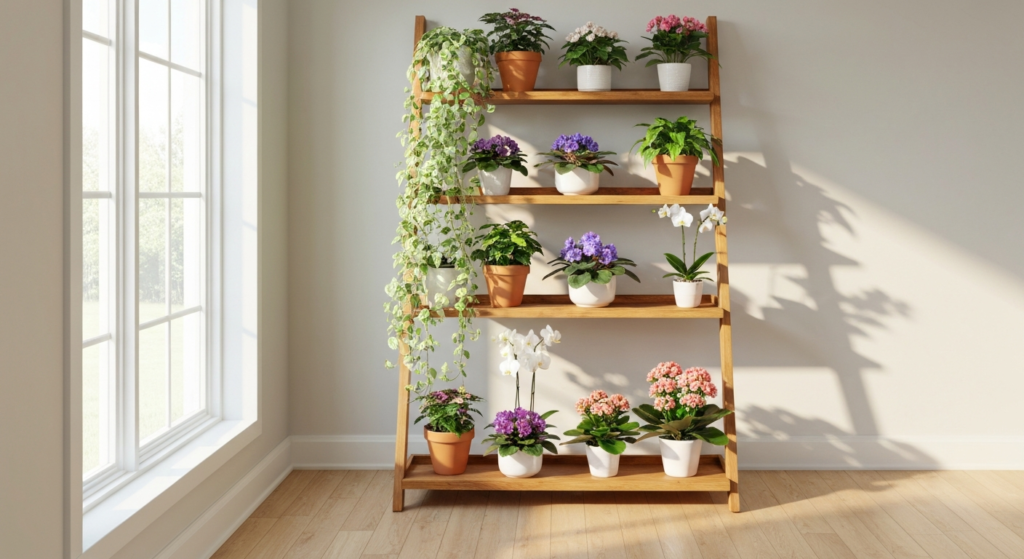

You’ve bought a beautiful ladder shelf. You’re excited to fill it with flowering plants. But when you start arranging them, something feels off. The trailing plants hide everything below them. The upright ones look awkward. You water one plant and drip all over the others. Your Pinterest vision isn’t matching reality.
I’ve been there. The problem isn’t your plants or your shelf—it’s knowing which bloomers go where and how to arrange them so they actually thrive. A badly planned ladder shelf becomes a watering nightmare and a visual mess within weeks.
Here’s what you’ll learn: how to pair trailing and upright flowering plants, where to place each type for both beauty and practical care, and how to create a display that looks curated without constant rearranging.
I’m Darcey Wren, and I’ve spent years working with indoor flowering plants in various settings—from compact apartment shelves to larger plant collections. Through trial and plenty of error, I’ve learned that successful ladder shelf displays aren’t about cramming in as many plants as possible. They’re about understanding growth patterns, light distribution, and realistic maintenance. When I first started arranging flowering plants on vertical shelves, I made every mistake: placing heavy waterers above dry-soil lovers, blocking light from lower tiers, and creating arrangements I couldn’t maintain without moving half the plants. What I’ll share comes from figuring out what actually works day-to-day.
Understanding Your Ladder Shelf Structure
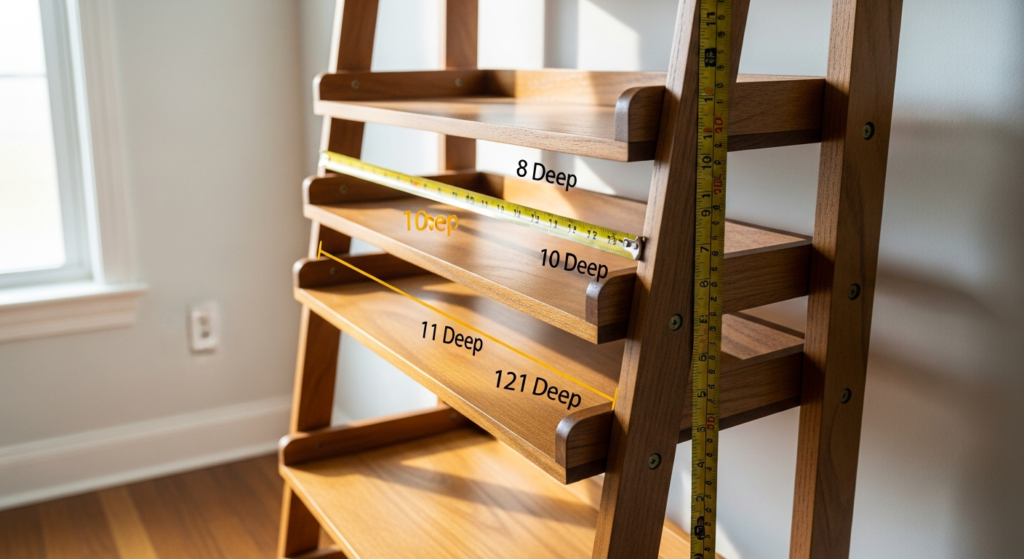
Before buying a single plant, look at your ladder shelf’s measurements. Most ladder shelves have 3-5 tiers, with each level getting progressively smaller as you go up. This creates a natural display gradient, but it also creates specific challenges for plant placement.
The top shelf usually gets the most light, especially if your shelf sits near a window. Middle tiers receive filtered light. Bottom shelves often end up in partial shade, which some flowering plants tolerate better than others.
Measure the depth of each shelf. Standard ladder shelves offer 8-12 inches of depth. This matters because trailing plants need front-edge placement, while upright bloomers can sit further back. If you don’t account for this, trails will block your view of everything else.
Consider the width too. A 24-inch wide shelf can comfortably hold 2-3 small pots per tier without crowding. Wider shelves give you more flexibility, but they also tempt you to overfill—which creates a watering obstacle course.
Traffic Flow Around Your Shelf
Position your ladder shelf where you can access all sides, or at least where the front remains completely open. I learned this after placing a shelf against a wall in a narrow hallway. Watering the back plants meant awkward reaching, spills, and eventual neglect of anything I couldn’t easily touch.
Leave at least 2 feet of clearance in front of your shelf. You’ll need this space for watering, deadheading spent blooms, and checking soil moisture. Flowering plants demand more attention than foliage-only varieties, and difficult access means you’ll skip necessary care.
Think about the drip factor. When you water a plant on a middle tier, where does the excess water go? If it drips onto plants below, you’ll either overwater those lower plants or you’ll need to move things every time you water. Neither option works long-term.
Trailing Bloomers for Ladder Shelves
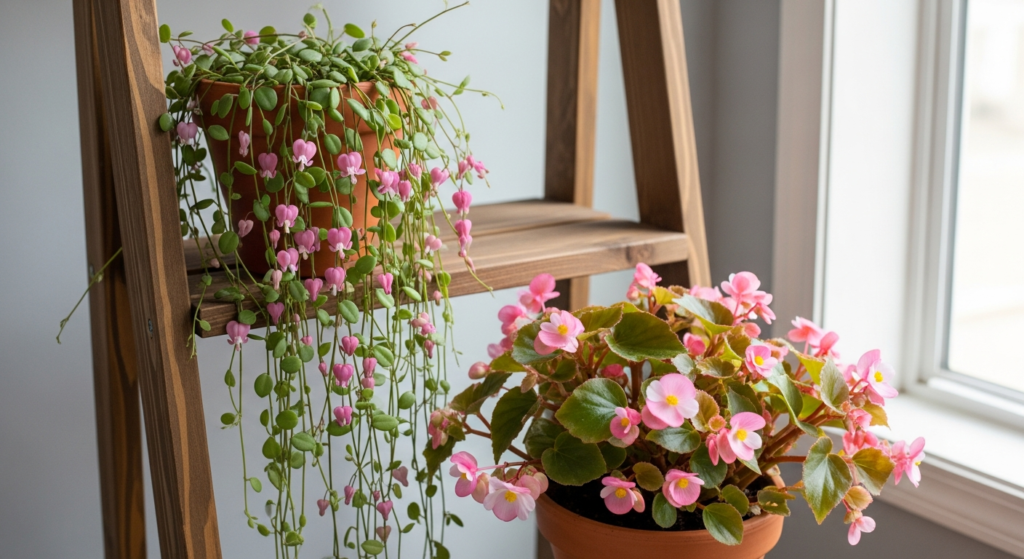
Trailing flowering plants create that cascading effect you see in photos, but they need strategic placement. Put them too high, and their trails block everything below. Place them too low, and they puddle on the floor.
String of Hearts (Ceropegia woodii) produces delicate pink tubular flowers along thin, trailing stems. The vines can grow several feet long. I keep mine on the second-from-top shelf, which gives the trails room to cascade without overwhelming the bottom tier. The stems reach down about 18-24 inches before I trim them back.
Trailing Begonias offer clusters of pink, white, or red blooms. Unlike String of Hearts, these plants have fuller foliage that creates a denser curtain effect. They work best on the very top shelf where their bulk doesn’t shade lower plants. Their soil needs to dry slightly between waterings, which becomes important when you’re planning vertical arrangements.
Lipstick Plant (Aeschynanthus) grows tubular red or orange flowers from trailing stems. These plants prefer consistent moisture, so I place them where I can water without disrupting the whole arrangement. Top or second shelf works well, but not directly above plants that hate wet feet.
Here’s a comparison of common trailing bloomers:
| Plant | Light Needs | Watering Pattern | Trail Length | Bloom Season |
|---|---|---|---|---|
| String of Hearts | Bright indirect | Let dry completely | 2-4 feet | Summer |
| Trailing Begonia | Medium to bright | Slightly moist | 1-2 feet | Year-round |
| Lipstick Plant | Bright indirect | Consistently moist | 1-3 feet | Spring-Summer |
| Hoya (some varieties) | Bright indirect | Dry between waterings | 3-6 feet | Summer |
Upright Bloomers That Hold Their Shape
Upright flowering plants create structure and prevent your shelf from looking like a green waterfall. These plants maintain compact forms and typically bloom at the top of their growth.
African Violets (Saintpaulia) stay under 8 inches tall and produce clusters of purple, pink, or white flowers. They bloom almost continuously under the right conditions—bright indirect light and consistent moisture. I keep three different varieties on my middle shelf, staggered at different depths to create visual interest without blocking each other.
Small Orchids (Phalaenopsis) work surprisingly well on ladder shelves if you choose compact varieties. The flower spikes grow upright, adding 6-10 inches of height during bloom periods. Between blooms, the foliage stays low and tidy. Place these where you can easily check their roots—orchids in clear pots make this simpler.
Kalanchoe offers thick, succulent leaves topped with clusters of bright flowers in red, pink, yellow, or orange. These plants prefer to dry out between waterings, making them good companions for other succulents on your shelf. They stay compact at 6-12 inches tall.
Miniature Roses can work on the larger shelves if you maintain them carefully. These need more light than most indoor bloomers, so reserve your top, brightest shelf for them. They’ll reach 10-14 inches tall and need regular deadheading to continue blooming.
Creating Visual Balance
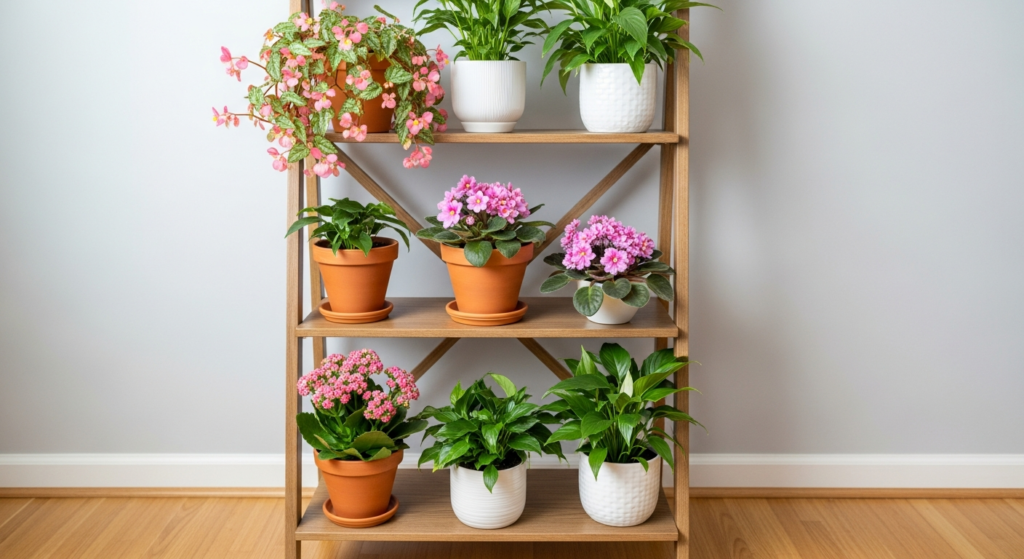
A well-balanced ladder shelf alternates heights, colors, and plant densities. But balance doesn’t mean symmetry. Perfectly matched sides look stiff and unnatural.
Start with your anchor plant—usually your largest or most visually striking bloomer. This might be a fuller trailing begonia on top or a particularly vibrant kalanchoe on a middle tier. Build around this anchor.
Use the “triangle rule” I picked up from arranging plants in various spaces: create triangular sight lines between your most colorful or interesting plants. If you have a pink trailing begonia at top left, place a pink African violet at middle right, and perhaps another pink bloomer at bottom left. This creates visual movement that guides the eye across the entire display.
Vary your pot colors and textures, but stick to a limited palette. Three pot colors maximum keeps things cohesive. I use mostly terracotta with a few white ceramic pots for contrast. Too many pot styles compete with your flowers for attention.
Light Distribution Strategies
The top shelf receives the most light, but you can modify light levels throughout your ladder shelf with careful placement and occasional rotation.
Place high-light bloomers (miniature roses, some orchids, lipstick plants) on top shelves. Medium-light plants (African violets, trailing begonias) do well on middle tiers. Lower shelves should hold the most shade-tolerant bloomers or plants between bloom cycles.
If your ladder shelf sits perpendicular to a window rather than facing it, rotate your plants weekly. The plants closest to the window will lean toward the light source, creating an unbalanced look. A quarter-turn each week keeps growth even.
Some people use supplemental grow lights clipped to their ladder shelves. This works if your room lacks good natural light, but choose compact LED strips rather than bulky fixtures that disrupt the aesthetic you’re building.
Watering Systems for Vertical Arrangements
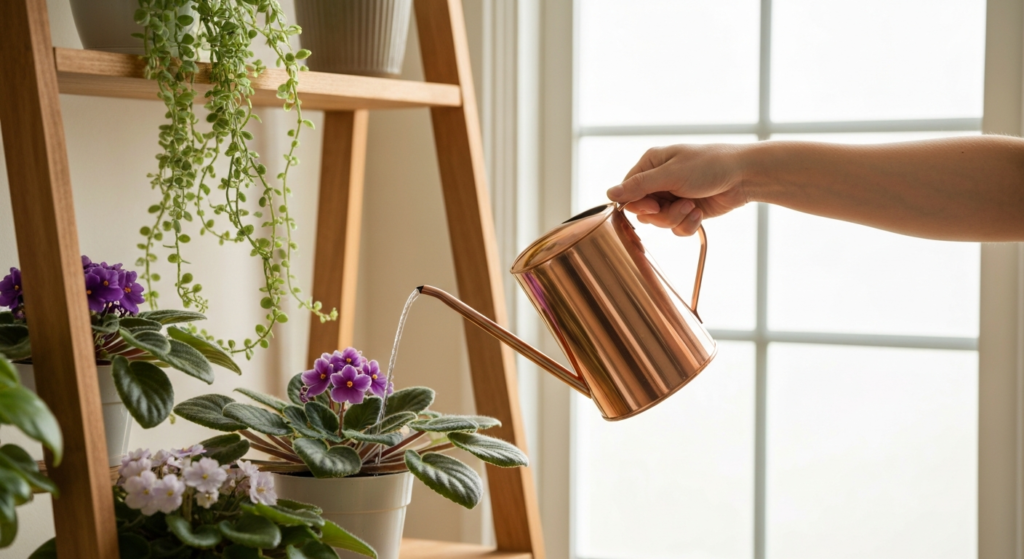
This is where most ladder shelf arrangements fail. Watering from top to bottom seems logical but creates drip problems. Watering each plant individually takes forever and invites spills.
I use a combination approach. Plants that need frequent watering (lipstick plants, African violets) go on shelves where I can easily remove them. I take these to the sink, water thoroughly, let them drain, then return them to the shelf.
Drought-tolerant bloomers (kalanchoe, string of hearts, some hoyas) stay in place. I water these less frequently with a narrow-spout watering can, using just enough water to moisten the soil without creating runoff.
Never place a heavy waterer directly above a plant that prefers dry conditions. This sounds obvious, but I’ve watched drips from a trailing begonia slowly kill a kalanchoe below it. Even with saucers, humidity and occasional overflow happen.
Here’s a watering compatibility guide:
| Plant Type | Water Frequency | Good Shelf Neighbors | Bad Shelf Neighbors |
|---|---|---|---|
| African Violet | Every 4-7 days | Lipstick plant, small orchids | Kalanchoe, string of hearts |
| Trailing Begonia | Every 5-7 days | African violet, orchids | Succulents, cacti |
| Kalanchoe | Every 10-14 days | String of hearts, hoyas | African violet, begonias |
| String of Hearts | Every 10-14 days | Kalanchoe, hoyas | Frequent waterers |
Combining Compact and Cascading Forms
The magic happens when you intentionally pair compact bloomers with trailing varieties. The trails add softness and movement. The compact plants provide color punches and structure.
On my top shelf, I keep a trailing hoya on the left side and two small African violets on the right. The hoya’s vines cascade down the left edge, creating an asymmetrical frame. The violets stay compact and colorful, drawing the eye upward.
Middle shelf holds a lipstick plant at the front right corner (trails down about 18 inches) and a kalanchoe toward the back left. The kalanchoe’s upright form contrasts with the lipstick plant’s flow.
Bottom shelf features two orchids (currently not blooming) and a small trailing string of hearts at the back. This arrangement seems backward—trailing plant in back?—but the string of hearts has thin stems that drape over the orchid pots without blocking them. It adds texture without overwhelming the space.
Seasonal Rotation and Bloom Cycles
Not all flowering plants bloom year-round. Accept this reality and plan for it. A well-designed ladder shelf looks good even when some plants are between bloom cycles.
I keep a rotation system. When an orchid finishes blooming, it moves to a lower shelf where its foliage still looks good but doesn’t occupy premium space. A plant starting to bud moves up to a more visible position.
Seasonal changes affect bloom schedules. Many trailing plants bloom more in summer months when light is abundant. Upright bloomers like African violets can flower year-round but may take occasional breaks.
Keep 2-3 “reserve” flowering plants that aren’t on your ladder shelf. When something stops blooming or needs a rest period, swap it out. This rotation keeps your display looking fresh and gives each plant what it needs.
Color Coordination Without Overthinking
Stick to a simple color story: either complementary colors (purple and yellow, pink and green) or analogous colors (pink, purple, red). Too many competing colors create visual chaos on a ladder shelf’s limited space.
I work with pink and purple bloomers primarily—trailing begonias, African violets, string of hearts, some orchids. This limited palette lets me focus on form and texture rather than worrying about color clashes.
White flowers work as neutrals. They pair with anything and brighten darker shelves. A white African violet can bridge different color zones on your shelf.
Green foliage counts as color too. Variegated leaves add visual interest between bloom periods. String of hearts has beautiful silver-and-green foliage. Some begonias offer patterned leaves that rival their flowers for beauty.
Common Mistakes and How to Fix Them
Overcrowding the shelves. More plants don’t equal better displays. Leave breathing room. Each plant should have space to show its form without competing with neighbors. If you can’t easily reach each pot, you have too many plants.
Ignoring growth patterns. That small trailing plant you bought will grow. Plan for mature size, not nursery size. I’ve had to completely rearrange shelves because a hoya grew 3 feet longer than I expected.
Matching watering needs to aesthetics instead of plant health. Just because two plants look good together doesn’t mean they should share a shelf if one needs frequent water and the other prefers drought. Aesthetics matter, but plant health determines long-term success.
Forgetting about deadheading access. Flowering plants need regular maintenance. If you can’t easily reach spent blooms to remove them, your plants will bloom less and look messier. This is especially true for African violets and miniature roses.
Building a Curated Look
That “curated” aesthetic you see on Pinterest doesn’t happen by accident. It requires editing and restraint.
Choose pots that share a similar style even if they vary in size. All terracotta, all white ceramic, or all neutral colors work better than a random collection of leftover containers.
Limit your plant variety. Five different types of flowering plants arranged thoughtfully looks more curated than fifteen varieties crammed together. Repetition creates cohesion—use multiples of the same plant species in different locations on your shelf.
Add one or two non-plant elements if your shelf has room. A small watering can, a vintage botanical print, or a simple decorative object can enhance the display without cluttering it. Keep these items minimal. The plants should remain the focus.
Negative space matters. Empty spots on your shelves aren’t failures—they’re breathing room. They let each plant stand out. They make your display look intentional rather than cluttered.
Maintenance Schedules That Actually Work
Create a simple weekly routine. Every Sunday (or whatever day works), I do a quick check: look for spent blooms, check soil moisture on all plants, rotate pots that are leaning toward light, and wipe dust off leaves.
Monthly, I do deeper maintenance: fertilize blooming plants, trim back trails that have gotten too long, inspect for pests, and consider whether anything needs repositioning.
Keep a small notebook nearby with bloom dates and observations. When did the orchid start blooming? When did you last fertilize the African violets? This information helps you notice patterns and catch problems early.
Don’t move plants unless necessary. Constant rearranging stresses plants and prevents you from learning what works. Give an arrangement at least 4-6 weeks before deciding it doesn’t work.
Troubleshooting Common Issues
Lower shelves stay too dark. Add a small clip-on grow light or accept that these shelves work better for plants between bloom cycles. You can also paint the wall behind your shelf white to reflect more light.
Trails grow unevenly. This usually means uneven light exposure. Rotate the pot weekly or move it to a different shelf position where light hits more evenly.
Blooms don’t last long. Check your watering, light levels, and temperature. Most flowering houseplants prefer consistent conditions. Wild swings in any factor will shorten bloom periods.
The whole arrangement looks messy. Step back and identify what’s creating chaos. Usually it’s too many trailing plants, too many colors, or lack of regular deadheading. Remove one element and see if clarity improves.
Adapting to Your Space
Every home has different light conditions, humidity levels, and available space. The arrangements I describe work in bright indirect light with moderate humidity. Your conditions might require adjustments.
Low-light spaces need shade-tolerant bloomers. Focus on African violets, which can bloom in moderate light, and accept that trailing plants may not flower as abundantly.
High-light spaces (south-facing windows) let you grow sun-lovers like miniature roses and some succulents with bright blooms. But watch for leaf burn on plants placed too close to intense afternoon sun.
Dry air from heating systems affects flowering plants. Grouping plants on your ladder shelf creates a small humidity zone through collective transpiration. This helps, but you may still need to run a humidifier during winter months for tropical bloomers.
FAQ
How many plants should I put on each shelf tier?
It depends on shelf width and pot size, but generally 2-3 small to medium pots per tier prevents overcrowding. A 24-inch wide shelf comfortably holds two 4-inch pots and one 6-inch pot. Leave at least 2-3 inches between pots for air circulation and growth room.
Can I use all trailing plants or all upright plants instead of mixing them?
You can, but mixing creates more visual interest and better uses your vertical space. All trailing plants will look unbalanced and heavy at the top. All upright plants miss the opportunity to add movement and softness that trails provide. The combination creates depth and texture that single-type arrangements lack.
What’s the best way to water without making a mess?
Use a narrow-spout watering can for in-place watering of drought-tolerant plants. For heavy waterers, remove the pot, take it to a sink, water thoroughly, let drain completely, then return it. Keep a small towel near your shelf to wipe up any drips immediately. Consider placing clear plastic saucers under pots on upper shelves to catch overflow before it drips onto plants below.
How do I keep my display looking good when plants aren’t blooming?
Choose plants with attractive foliage, not just flowers. String of hearts has beautiful variegated leaves. Many begonias offer patterned foliage. Use the rotation method—move non-blooming plants to less prominent positions and bring budding plants forward. Accept that some seasonal variation is natural and even a well-planned shelf will have quieter months.
Conclusion
A successful ladder shelf display balances beauty with function. Place trailing bloomers where their cascades enhance rather than block. Position upright varieties to create structure and color focal points. Plan your watering strategy before you arrange anything, and give yourself access to every plant for regular maintenance.
The curated look comes from restraint—fewer plant varieties, cohesive pot choices, and intentional use of space. Your shelf will evolve as plants grow, bloom, and rest. That evolution is part of the appeal.
Start with 4-6 flowering plants total. Learn how they behave in your specific conditions. Add more only after you’ve established a maintenance rhythm that works.
What’s been your biggest challenge with vertical plant displays—getting the watering system right, or finding the right plant combinations? Share your experiences in the comments below.